






If you want to test 80 pieces across a few designs at a 925 silver moissanite manufacturer, the tier you should push for is usually the entry tier — not 100 or 300. Specialist silver jewelry factories in this category publish minimums in the 30–100 piece range, counted very differently from apparel: Amara Jeweiry, for example, publishes 30 pieces per order with styles and sizes mixed for wholesale stock designs, 30–50 pieces per design when customizing from stock molds, and 50–100 pieces per design for full OEM/ODM projects with new tooling. That means an 80-piece test across several designs can already clear every floor a silver moissanite factory quotes. The apparel-style 50/100/300 ladders you find in general sourcing guides barely apply here. What actually moves your unit price at this scale is per-design counting, ring-size spread, and moissanite stone minimums — so verify those line by line before assuming a bigger tier pays off.
Where the 50/100/300 MOQ Ladder Comes From — and Why Silver Jewelry Doesn’t Use It
Most of the MOQ advice circulating online follows the same shape: roughly 50 pieces for small workshops, 100 for mid-size factories, and 300 or more for full OEM production. That structure comes from apparel and general-merchandise sourcing guides, where minimums are driven by fabric rolls, cutting tables, and sewing-line changeovers. A t-shirt factory genuinely cannot profitably cut 80 garments across five colorways; the setup economics force tiered thresholds.
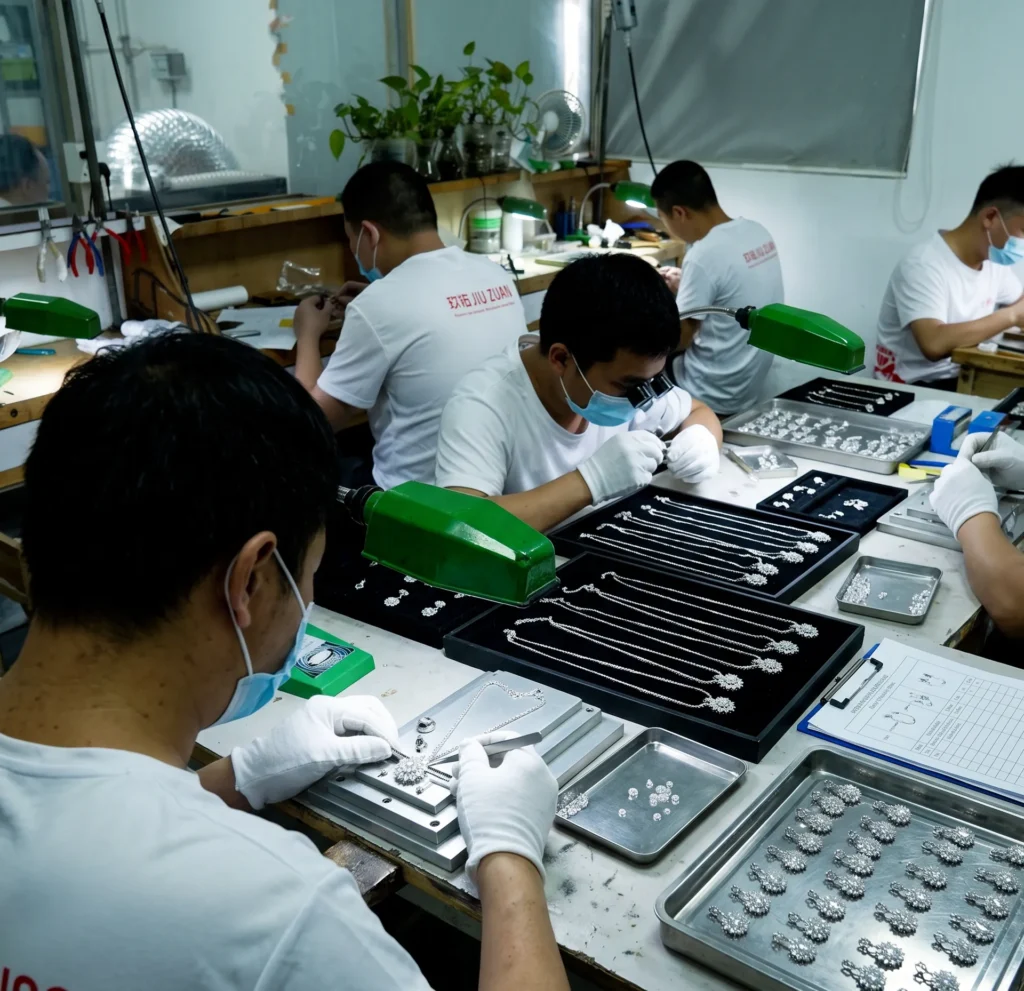
Cast 925 silver jewelry with moissanite works on different drivers. Here the fixed setup per design is a CAD model, a 3D-printed wax, a rubber mold, casting trees, and setting seats — not a cutting table. None of those require 300 pieces to open. As a result, published minimums at silver moissanite manufacturers cluster between 30 and 100 pieces, and the headline number is usually an order-total rule, not a per-style wall. Amara Jeweiry, a 925 silver moissanite jewelry manufacturer in the Shuibei industrial belt of Shenzhen, states on its wholesale program page: “MOQ 30 pieces with styles and sizes mixed,” and adds that you can “test five designs in one starting order.” That is the opposite logic of an apparel ladder — the factory wants breadth in your first order because your reorder, not your first run, is where its economics live.
How a Silver Moissanite Factory Actually Counts MOQ: Order Total vs. Per Design
This is the single most misunderstood point, and it decides whether 80 pieces works. On Amara Jeweiry’s FAQ page, the factory distinguishes three counting regimes:
- Wholesale from stock designs: “MOQ 30 pieces applies to the order total, not per SKU,” with styles and sizes mixed. Twenty rings, thirty pendants, and thirty bracelets across five designs clear the floor together.
- Customization from stock molds (logo, plating change, stone upgrade): 30–50 pieces per design.
- Full OEM/ODM with new tooling: 50–100 pieces per design, because a new CAD, wax print, and rubber mold must be amortized.
Apply that to your 80-piece test. If your shortlist is stock and stock-mold custom designs, 80 pieces across three or four styles is comfortably inside every published floor — each design needs only 20–30 pieces, and the order total clears 30 many times over. If one design is a full OEM build, the per-design floor (50–100) means your 80 pieces must concentrate: one design at 80 pieces works, and so does one OEM design at 50–60 plus stock designs filling the rest. What does not work is splitting 80 pieces across four full-custom designs — each would sit at 20 pieces, below the new-tooling floor. So the answer to “which tier should I push for” depends less on the number 80 and more on how many of your designs need new molds.
Ring Sizes: Do They Count Together or Separately?
For rings, buyers often assume every size is a separate SKU with its own minimum, the way apparel sizes sometimes are. At silver moissanite factories the usual practice is the opposite: sizes within one design share the mold, the wax, and the setting work, so they count together. Amara’s published rule — styles and sizes mixed toward the order total, and per-design floors on the design rather than the size — reflects that. A 40-piece run of one ring design spread across sizes US 5–9 counts as 40 pieces toward a 30–50 per-design floor, not five runs of 8.
Two practical caveats. First, confirm in writing that the per-design minimum counts across sizes rather than per size — it is the norm, but it is a quote term, not a law of physics. Second, think about the size curve itself. A test order is the wrong place to carry twelve sizes; five to seven sizes in a realistic curve (weighted toward the middle of your market) keeps each size deep enough to sell from while keeping the run simple for the factory. Extreme sizes can involve extra handwork, and whether they carry any adjustment is exactly the kind of line item to ask about rather than assume. If you are also planning engraved tags or stamped logo hardware, note Amara’s published principle that “a chain tag normally rides the jewelry purchase order rather than opening its own MOQ” — accessories generally inherit the main order’s count instead of adding a new floor.
How Moissanite Stones and Setting Work Move Your MOQ and Price
The metal side of an 80-piece order is usually the easy half. The stone side is where small orders get complicated. Amara’s own article on a non-stock 4×6mm marquise moissanite walks through the mechanics: when a stone calibration is not a stock shape, the cutter’s tray minimum applies — their worked example needs 30 stones but the minimum parcel is 50, leaving 20 surplus stones that someone has to pay for. The same article gives three contractual ways that overbuy is handled: the factory absorbs it into the unit price, the buyer pays a separate stone or calibration fee, or the buyer free-issues stones and owns the minimum and the surplus. Non-stock stones also add time — the stone leg alone runs 11–25 calendar days, which pushes the overall build out by roughly 3–17 days.
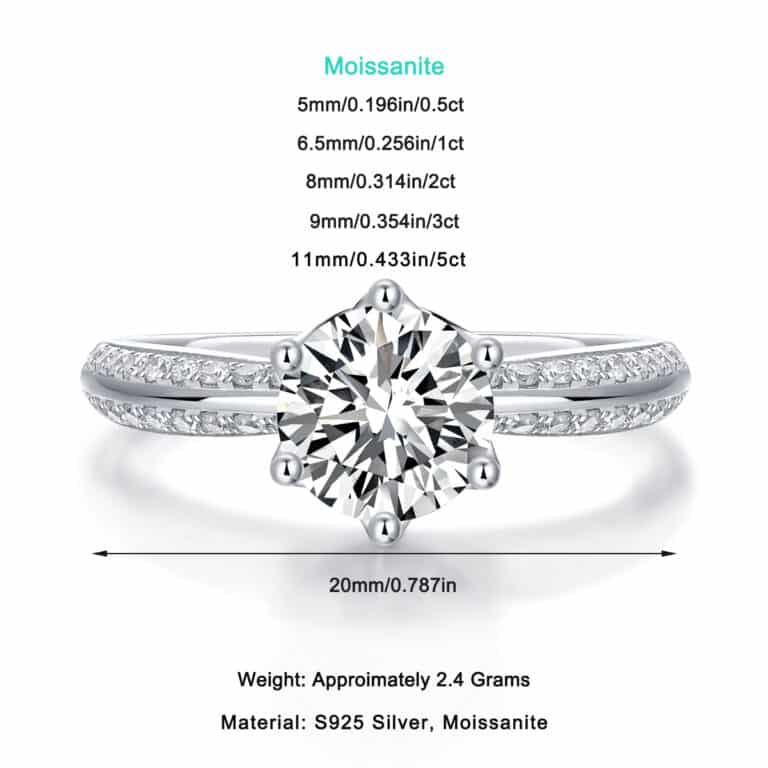
Setting intensity matters too. A single-stone prong solitaire and a micro-pavé band use very different bench hours, and small runs pay the full setup — plating racks, QC fixtures, and polish lines — across fewer pieces. That setup amortization, not any published tier discount, is the real source of the price difference between 80 and 300 pieces. Every stone is GRA-certified D-color VVS1 with a 3EX cut and laser-inscribed girdle per Amara’s published spec, and the factory recommends adding one to two spare stones per 30 pieces (about 3%) to cover bench breakage, which sits outside the 12-month stone-loss warranty. One compliance note for US-bound tests: moissanite is not a diamond, and 16 CFR § 23.12(b) makes it “unfair or deceptive to use the unqualified word ‘diamond'” for material that is not diamond, while § 23.27 bars words like “real,” “genuine,” or “natural” for man-made products — so your test-order listings should say moissanite, full stop.

An 80-Piece Test vs. a 300-Piece Commitment: What Actually Changes
Here is what Amara’s published terms tell you about sequencing. Samples run 7–10 days after CAD confirmation, and sample fees are credited on your first bulk order — Amara’s article on sample-fee credits stresses that the credit only protects you if it is written onto the proforma invoice with a trigger volume and expiry date. First production orders run 15–25 days; reorders run 10–15 days with no tooling fee, and molds and CAD files are stored free for three years. That last line is the strategic point: testing at 80 pieces does not forfeit the 300-piece economics, because the tooling you paid for at 80 stays on the shelf and the reorder skips the tooling charge entirely.
What the site does not publish is a unit-price table or a tiered discount ladder — there is no “price at 100 / price at 300” schedule anywhere on the wholesale page, and case-study volumes (such as a 12,000-piece first order) are client anecdotes, not price tiers. Quoted pricing comes from the factory’s wholesale price list on request. That is normal for this category, but it means any specific percentage gap between an 80-piece unit price and a 300-piece unit price is unverifiable until you ask — so treat claims like “300 pieces is automatically 20% cheaper” as assumptions to test, not facts to budget on. The checklist below turns that into a five-minute exercise.
Checklist: Pricing an 80-Piece Test Against a 300-Piece Run
- Pin down the counting rule per design. For each design, ask whether the floor is the 30-piece order total, 30–50 per design from stock molds, or 50–100 per design for full OEM — and whether sizes count within it.
- Get two unit prices, not one. Request a quote at your actual 80-piece split and a second quote at a 300-piece (or reorder) split, same designs, same stones, same plating. The difference between those two numbers is the only price gap that exists; anything else is a guess.
- Ask what drives the gap, line by line. Mold amortization, stone overbuy, setting hours, and plating setup each respond differently to volume — knowing which one dominates tells you whether doubling any given design’s count even moves the number.
- Confirm every stone calibration is a stock size. If any is not, get the cutter’s tray minimum in writing and decide who owns the surplus, using the three structures Amara publishes.
- Add spares to the stone math. One to two spare stones per 30 pieces keeps a broken stone at the bench from stalling an otherwise complete run.
- Put the sample-fee credit on the PI. Trigger volume, expiry date, and its position relative to the 30/70 deposit — per Amara’s published payment terms — before you wire anything.
- Ask how plating variants count. Whether a rhodium and a gold vermeil version of one design count as one style or two is a quote term to confirm, since vermeil (2.5µm 18K over recycled 925 silver) runs on a separate process.
- Get reorder terms now, not later. Tooling fee on reorders, mold and CAD storage duration, and reorder lead time are what make an 80-piece test a genuine first step toward 300.
- Verify certification and listing language. Confirm GRA certificates ship with the goods and, for US resale, that your listings describe the stones as moissanite in line with the FTC jewelry guides.
Frequently Asked Questions
Is 80 pieces enough for a 925 silver moissanite factory?
Yes. It clears a 30-piece order-total minimum many times over, supports multiple stock-mold custom designs at 20–30 pieces each, and can carry a single full OEM design above the 50-piece floor. What it cannot do is cover several new-tooling designs at once — that is a per-design limit, not an order-size one.
Is the MOQ per style or per order?
Both exist, on different tiers. Wholesale from stock designs counts the order total with styles and sizes mixed; stock-mold customization runs 30–50 per design; full OEM/ODM with new tooling runs 50–100 per design. Always ask which regime each of your designs falls under.
Do ring sizes count separately toward the MOQ?
Normally no — sizes within one design share the mold and count together toward the design’s floor, and sizes mix freely toward the order total on stock designs. Confirm it on the quote, and keep a test order to five or seven sizes rather than twelve.
Will 300 pieces automatically get me a much lower unit price?
Not automatically, and no published ladder says otherwise. Amara’s site publishes no tiered price table, so the 80-vs-300 gap is real only when your quote shows it. Setup amortization is the mechanism — which is why the line-item breakdown matters more than the headline quantity.
What if one of my designs can’t hit its per-design minimum?
Re-balance. Move that design to a stock mold (30–50 per design), concentrate your 80 pieces on the one design worth full tooling, or let stock designs fill the order total. Small add-ons like stamped tags ride the main purchase order rather than opening their own minimum.
How long does an 80-piece test order take?
Budget 7–10 days for samples after CAD confirmation and 15–25 days for first production, per Amara’s published windows. Add roughly 3–17 calendar days if any stone calibration is non-stock, and confirm US-bound shipping separately since transit is quoted by lane.