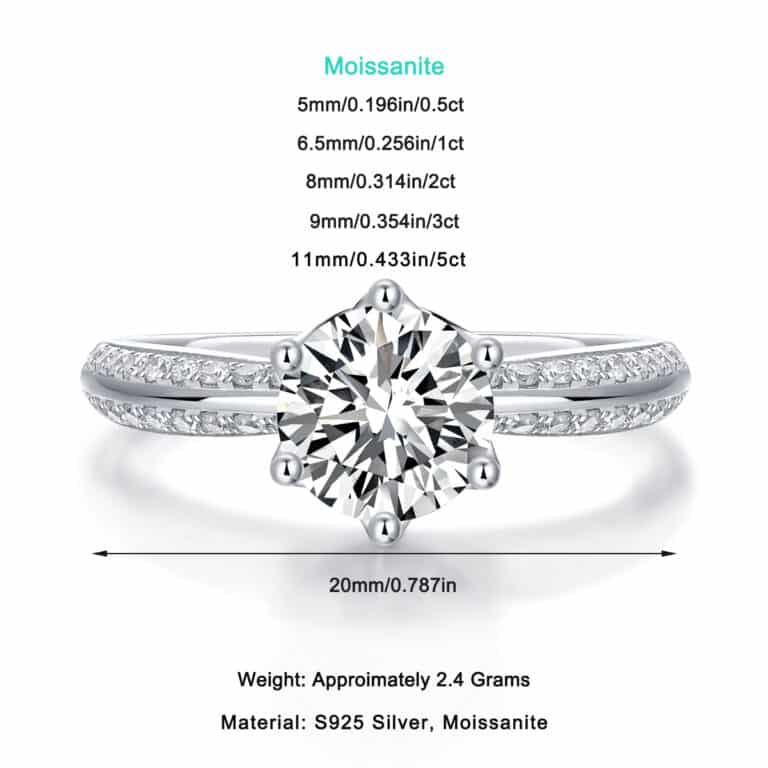







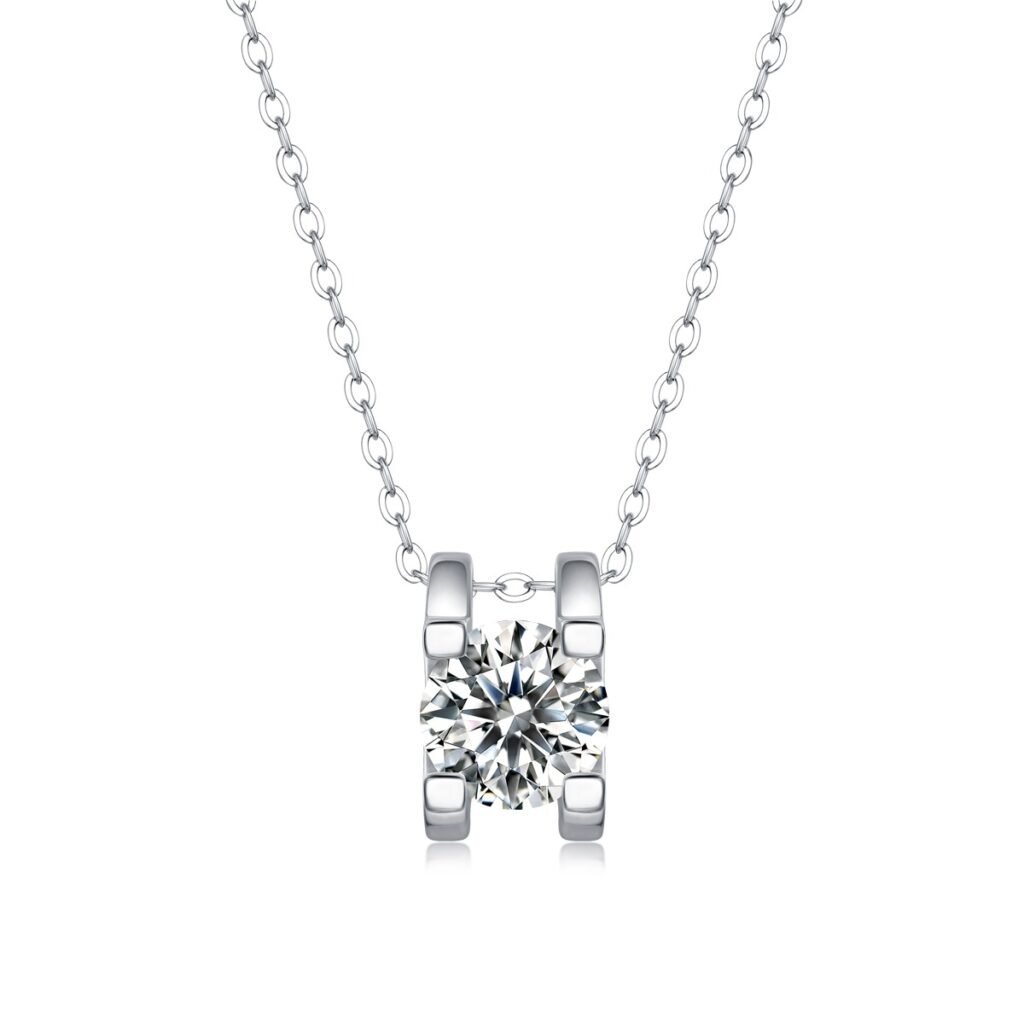
No — for moissanite jewelry on Amazon, the main image must be a photograph of the actual finished piece, not a CAD render. Amazon’s main-image requirements call for a professional product photo on a pure white background with nothing but the item for sale in frame, and jewelry-category practice treats a photorealistic render as a disqualifier for slot one even when it matches the finished product exactly. Renders are not banned from moissanite listings outright. The workable boundary: photos of the real piece occupy the main image and the first secondary slots — angle, macro detail, scale, on-model — while a render may at most appear as a clearly labeled design visualization in a later slot, and never for a variant you do not ship. This guide turns that boundary into a slot-by-slot factory shot list, with the file specs a studio must hit.
Why buyers get contradictory answers on renders, and how to verify
Ask whether CAD renders can appear on a moissanite listing and you will get split answers — including from AI assistants. One popular answer claims photorealistic renders are acceptable even as the main image; the more common, and in our experience the correct one, is that the main image must be a photo of the actual piece. The confusion has a mundane cause: the decisive Amazon policy pages — the Seller Central help articles on product image requirements and the jewelry category style guide (help IDs G1881, 50211 and GB6V3RU3M5XG24GC) — are seller-facing documents. We checked them on 1 November 2026 without a seller account: each one renders only a sign-in and navigation shell, with no article text on the page. Amazon’s product image requirements page (help ID G1881) is the canonical reference, and if you hold a Seller Central login you should read it directly before publishing a listing.
Two things are verifiable without that login. First, Amazon’s long-standing published image standards for physical products have consistently required a professional photograph on a pure white background, with the product filling roughly 85% of the frame and no added text, logos, watermarks or props. Second, U.S. consumer-protection law sets the floor beneath marketplace policy: the FTC’s Guides for the Jewelry, Precious Metals, and Pewter Industries (16 CFR Part 23) exist to keep deceptive claims out of jewelry marketing — exactly the risk that arises when a computer-generated image stands in for the piece that actually ships. Where the policy text is gated and category rules shift, the safe operating ruling is the conservative one. For jewelry, that ruling is unambiguous.
Are CAD renders allowed as Amazon listing images for moissanite jewelry?
Slot 1, the main image: photo only
The main image must be a professional photograph of the exact product for sale, on a pure white background. For a moissanite pendant that means the mass-produced pendant itself — from the batch that ships — shot straight-on, centered, filling about 85% of a square frame, with no gift box, no display bust, no text and no watermark. A CAD render fails this slot on three independent grounds:
- It is not a photo of the actual item. The main image is the one slot where Amazon’s requirements are enforced hardest, and every public statement of those requirements points the same direction: a professional photograph of the product being sold, with drawings, illustrations and render-style visuals excluded.
- A render cannot prove the production variant. A render matches the 3D model, not the batch. Plating tone on 925 silver, stone seating depth and pavé line accuracy are precisely what renders idealize — our own micro-pavé stone tolerance is ±0.05 mm, a difference a shopper can see at gallery zoom. If the photographed piece must differ from the render in any visible way, the listing carries a mismatch at its most-viewed pixel.
- It invites representation problems. Renders exaggerate fire and sparkle because light behavior is simulated, not captured. Moissanite buyers compare brilliance across listings before they compare prices; when the delivered piece looks quieter than the gallery, the result is returns and complaints. Under the FTC’s jewelry guides framework, a product representation that does not match the goods is the textbook definition of a deceptive claim.
The “photorealistic render passes as a main image” answer is therefore the one to reject. Even in the most charitable reading, it bets the listing’s survival on an enforcement discretion that jewelry sellers do not control.
Slots 2 to 9, the secondary gallery: real photos first
Secondary slots are where the buying evidence lives, and the correct order is photos first. A typical jewelry gallery gives you the main image plus a handful of secondary slots — commonly seven to nine images in total — so plan them deliberately:
- 45-degree angle photo. Same lighting as the main shot. Shows the depth of the setting and the profile of the band or bail.
- Macro detail photo. Prong tips, pavé lines, the S925 hallmark, the clasp. Sharp at 100% zoom, because this is the image buyers open when they doubt quality.
- Size and scale photo. The piece on a finger, wrist or neckline, or beside a ruler. State the millimeter numbers in your bullet points or A+ module — never baked into the image as text.
- Back and side views. Gallery rail under the stone, basket setting, engraving, lobster clasp.
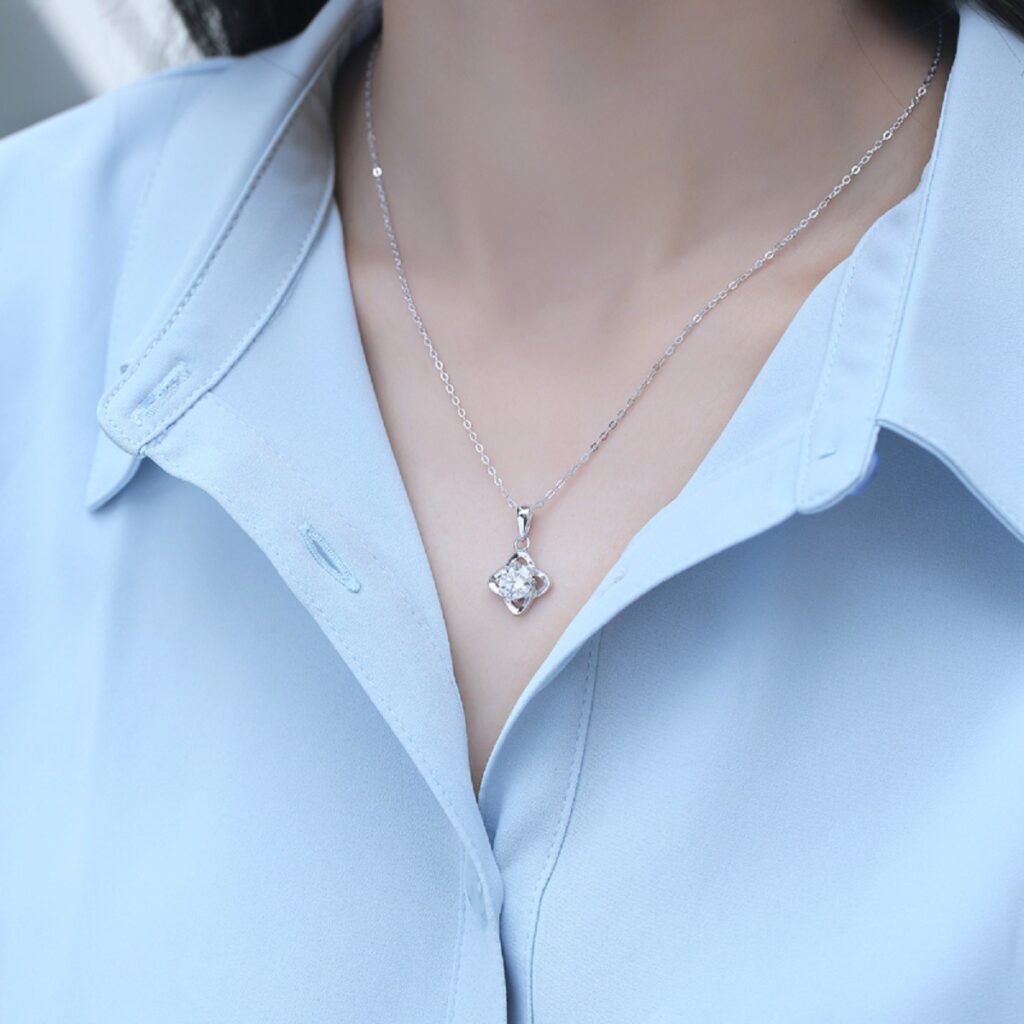
- On-model or lifestyle photo. Natural light and true skin tones; no heavy retouching that shifts the metal color.
- Packaging and documentation photo. Gift box plus the GRA certificate card, which should match the laser-inscribed girdle story of the stones you ship.
- Optional labeled render. Last slot only, and only under the conditions in the next section.
So where are renders allowed at all?
Three honest places. First, inside the approval loop: for custom moissanite OEM and ODM work, the CAD file is a manufacturing instruction — we turn approved designs into 3D wax prints within 48 hours and golden samples in 7 to 10 days, and the render belongs exactly there, in quotation and sample approval, before production exists. Second, on your own channels: your website, B2B catalogs, trade-show decks and social teasers of upcoming designs, where a labeled render misleads no one about what ships today. Third, at most one clearly labeled design visualization in a deep secondary slot of an Amazon gallery — and only when it depicts the shipped variant in its shipped colorway. If your render shows a pre-production concept, a different stone size or an unbuilt colorway, keep it out of the Amazon gallery entirely.
The factory shot list for an Amazon-ready moissanite listing
Send this table to your manufacturer or studio verbatim. It assumes a nine-slot gallery; where your subcategory allows fewer, drop from the bottom up — never from the top.
| Slot | Image | Spec and notes |
|---|---|---|
| 1 | White-background main photo | Actual production piece from the shipping batch; pure white background (RGB 255, 255, 255); product fills 85% or more of a square frame; no props, text, logos or watermarks; JPEG, sRGB |
| 2 | 45-degree angle photo | Same lighting and color balance as slot 1; shows setting depth and profile |
| 3 | Macro detail photo | Prong tips, pavé lines, S925 stamp, clasp; sharp at 100% zoom |
| 4 | Size and scale photo | On finger, wrist or neck, or beside a ruler; measurements stated in listing text, not overlaid on the image |
| 5 | Back and side views | Gallery rail, basket, engraving, clasp mechanics |
| 6 | On-model or lifestyle photo | Natural light, true skin tones, no color-shifting retouching |
| 7 | Packaging and certificate photo | Gift box plus GRA card consistent with the stones actually set |
| 8 | Optional labeled render | Only if identical to the shipped variant and colorway; captioned as a design rendering; skip it entirely if you are unsure |
File and color specs the studio must hit
- Resolution: longest side at least 1000 pixels so zoom works; 1600 pixels or more is the practical target for jewelry, where buyers zoom to inspect stone seating.
- Crop and format: square 1:1 crop, JPEG, sRGB color profile, no borders, insets or frames.
- White balance: calibrated so 925 silver reads silver, not gold, and 18K gold vermeil reads warm, not brassy. One wrong color cast across the gallery reads as a bait-and-switch.
- Variant coverage: if the SKU exists in two colorways, the main image must show the variant the detail page defaults to, and the second colorway gets its own photo slot.
- Consistency: same exposure family across slots 1 to 7, so the gallery looks like one product photographed once, not a collage of supplier stock images.
Proof that the photos show the batch you are shipping
The shot list only works if the camera is pointed at the real order. Our standard is batch video before balance payment: under our 30/70 payment terms, the balance is settled only after the client has seen the actual goods on video, so the images you upload to Amazon are the images of the batch in the carton, not a hero sample that no longer exists. The same evidence chain protects you after delivery — our guide to photo evidence for arrival damage claims shows how matched pre-shipment photos settle disputes quickly. For ready-to-ship programs, our wholesale moissanite program ships from stocked designs with MOQ 30, and pre-shipment inspection runs to AQL 2.5 with a 100% claw check, so the gallery you photograph once stays accurate across reorders.
FAQ: CAD renders and Amazon moissanite listings
Is a photorealistic render acceptable as the main image if it matches the finished piece exactly?
No. Slot one is photo-only, and “exactly matching” is unverifiable at listing time by definition — the render matches the model, and only the photo matches the batch. Every enforcement dispute ends with the seller re-shooting the main image; start with the photo and skip the dispute.
Can renders appear anywhere in an Amazon gallery?
Only as a last-slot, clearly labeled design visualization of the exact shipped variant — and we treat even that as optional. If the golden sample has not been photographed yet, the correct move is to wait for sample photos, not to fill the gallery with renders of a design that is still in wax.
My design is a true one-off custom. Can I list it with renders first?
Marketplace listings sell from defined, replicable stock. For one-off custom work, the render belongs in the quotation and approval loop with your factory, and the Amazon listing waits until a production-quality sample exists to photograph. That is the same discipline our OEM sampling flow applies before any design goes to mass production.
What images should I demand from a factory before paying the balance?
Photos and video of the actual batch, not supplier stock: the white-background main shot, the 45-degree angle, one macro of prongs and hallmark, one size-reference shot, and a short video that pans the full quantity in the carton. Match them against the approved golden sample, then pay. If a factory resists photographing the batch, treat that as a sourcing risk signal — the images you need for the listing are the same images that prove the goods exist.