







ที่เงิน 91.8% แหวน S925 อยู่ห่างจากคำตัดสินคนละขั้วสองขั้วเพียงสามในพัน ภายใต้ 15 U.S.C. § 296, ตรา 925 ยอมรับค่าคลาดเคลื่อน 4/1000 สำหรับเงินที่ไม่มียางบัดกรี ดังนั้นเกณฑ์ขั้นต่ำคือ 921‰; ที่ 918‰ แหวนไม่ผ่านห่าง 3/1000 และผลนั้นรองรับการเคลม หากห้องแล็บตรวจสอบทั้งชิ้นรวมยางบัดกรี กฎหมายยอมรับค่าคลาดเคลื่อน 10/1000 ดังนั้นเกณฑ์ขั้นต่ำคือ 915‰; 918‰ เดิมผ่านห่าง 3/1000 และไม่รองรับการเคลม ตัวเลขอย่างเดียวตัดสินคำถามนี้ไม่ได้ คุณต้องคำบรรยายตัวอย่างของรายงาน วิธีการทดสอบ และหลักฐานว่าแหวนมียางบัดกรีหรือไม่ โดยไม่มีข้อเท็จจริงเหล่านี้ 91.8% เป็นผลที่ยังไม่สมบูรณ์ ไม่ใช่คำตัดสิน ยกเว้นกรณีเดียวคือแหวนที่ไม่มียางบัดกรี ซึ่งเกณฑ์ขั้นต่ำ 921‰ เป็นผู้กำหนด และรายงานที่ละคำบรรยายตัวอย่างก็ยังทำให้ผลอยู่นอกเกณฑ์ที่ยอมรับได้.
ทำไม 91.8% อยู่ระหว่างเกณฑ์สองเส้น?
Start with the arithmetic, because it explains why two experienced people can look at the same report and reach opposite conclusions. An S925 mark means 925 parts per thousand. A result of 91.8% is 918 parts per thousand, which is 7 parts per thousand below the mark. The statute’s 4/1000 tolerance absorbs up to four of those seven parts. It does not absorb the other three. The whole-item allowance absorbs ten parts per thousand, so the same seven-part shortfall sits comfortably inside that line. One result, two distances.
| วัด | Parts per thousand | Percentage |
|---|---|---|
| 925 mark | 925‰ | 92.5% |
| 4/1000 floor, solder-free sample | 921‰ | 92.1% |
| Your assay | 918‰ | 91.8% |
| 10/1000 floor, whole item with solder | 915‰ | 91.5% |
The result is 3/1000 below the solder-free floor and 3/1000 above the soldered floor. That symmetry is the whole case in one line. The percentage did not change; the test object did.
15 U.S.C. § 296 บังคับจริง ๆ ว่าอะไร?
Section 296 sets the fineness standard for silver articles and then creates two tests with different sample requirements. The actual silver content may not be more than four one-thousandth parts below the fineness shown by the mark. The mark “sterling” specifically requires 925/1000 pure silver in the silver portion. The tested portion must not contain or have attached any solder or alloy of inferior fineness used for brazing or joining. A second proviso addresses soldered articles: the entire silver content, including solder and inferior alloys assayed as one piece, may not be less by more than ten one-thousandth parts below the marked fineness. The closing sentence says the standards and tests are “concurrent and not alternative.”
16 CFR § 23.5 allows “sterling” only at 925/1000 and subjects its marking rules to National Stamping Act tolerances; its footnote gives four parts per thousand without solder and ten parts per thousand with solder. Read together, the statute and the rule give two executable lines, not a range of opinions.
What is the 4/1000 rule for a solder-free sample?
Four parts per thousand is 0.4 percentage points, so the floor on a 925 mark is 921‰. The sample must come from a part with no solder attached. If the ring has no solder, the whole ring can serve, and 921 is the only floor. If it has a soldered joint, the lab must cut away from the joint; a reading that includes the joint is not a test of the solder-free portion.
What is the 10/1000 allowance for a soldered article?
Ten parts per thousand is 1.0 percentage point, so the floor is 915‰. The test is run on the entire silver content, including solder and inferior alloy, as one piece. Solder is not sterling, and a whole-item average is pulled down by the joint even when the body is correct. The allowance is a separate whole-item test, not a more generous definition of sterling.
Why are the two tests concurrent and not alternative?
The statute says so directly. A passing whole-item assay does not excuse a failing solder-free assay, and the reverse is also true. For a soldered ring, both lines must be satisfied. Most claim arguments fail here: one side cites 91.5, the other cites 92.1, and neither checks which sample the lab ran.
คุณนำเกณฑ์สองเส้นมาใช้กับรายงาน 91.8% อย่างไร?
Classify the report before you argue about the number. Two facts decide the outcome: whether the ring contains solder, and whether the assayed sample included it.
| Ring contains solder? | What the lab assayed | Floor that applies | 918‰ result |
|---|---|---|---|
| ไม่ | The whole ring, necessarily solder-free | 921‰ | Fails by 3/1000; claim |
| ไม่ | Report does not say | 921‰ | Fails by 3/1000; claim (sample description still needed for the file) |
| ใช่ | A solder-free portion | 921‰ | Fails by 3/1000; claim |
| ใช่ | The entire ring, solder included | 915‰ | Passes by 3/1000; no claim on this report |
| ใช่ | Report does not say | Neither can be applied | Inconclusive; clarify or retest |
No solder. The 10/1000 allowance has no application. A 91.8% whole-ring result is 7/1000 below the mark and outside the 4/1000 tolerance. Claim.
No solder, silent report. The ring itself supplies the answer: with no solder anywhere in the piece, any sample the lab took was solder-free, whether the report calls it a whole-ring assay or a body assay. The 921‰ floor governs and 91.8% is 3/1000 outside it. Claim, and put a bench note or photo documenting the absence of solder in the file so the sample description is not the weak point.
Solder present, solder-free sample. The body is below its own floor. The whole-item allowance does not rescue it, because the tests are concurrent. Claim.
Solder present, whole item assayed. This shows compliance with the whole-item test, not a violation, but it does not prove the body meets 921. Commission a solder-free assay if you need that answer. Do not call the report proof of overall compliance.
Silent report, solder present. Here the silence matters, because 921 and 915 point to opposite verdicts. A result without a sample description is not a legal finding. Ask for bench notes, sample photos, and method; if the sample was consumed and the notes do not say whether solder was excluded, retest.
คุณอ่านคำบรรยายตัวอย่างและวิธีการในรายงานของห้องแล็บอย่างไร?
The number is only as good as the sample and the method behind it. Ask four questions before you treat a report as evidence.
- What exactly was assayed? Look for “solder-free portion,” “body,” “entire article,” “including solder,” or “excluding solder.” A report that says only “silver content: 91.8%” has not answered the legal question for a soldered piece. If the ring has no solder, the 921‰ floor governs whatever the sample is called, but the report should still identify the sample for the file.
- Was the sample cut away from joints? A lab can test a ring and still include a sizing seam if the sample location was not documented.
- Which method? Fire assay is a destructive bulk method and the usual referee for disputed silver content. XRF is non-destructive and surface-weighted; plating, tarnish, polishing residue, or solder in the beam path can skew it. If the result is XRF and near a line, confirm with fire assay.
- What is the uncertainty, and how many readings support the result? A single surface reading and a duplicate fire assay do not carry the same evidential weight.
If the ring is gold-plated or vermeil, assay the silver substrate. An XRF reading can be dominated by the gold layer; the lab should remove the plating or test a cross-section and say so. Rhodium and heavy anti-tarnish coatings raise the same issue.
ข้อผิดพลาดอะไรทำให้การเคลมที่สมบูรณ์กลายเป็นถูกปฏิเสธ?
Mistake 1: Using 92.0% as the soldered floor
The soldered floor is 915‰, not 920‰. A 5/1000 allowance is not in the statute. If a supplier says 91.8% is “above 92.0, so it is fine,” ask which sample was assayed and which line they cite. Whole-item: 91.8 passes above 915. Solder-free: it fails below 921. The line matters more than the round number.
Mistake 2: Treating lab repeatability as a legal tolerance
Labs report uncertainty; the statute sets a fixed allowance. A lab’s stated repeatability does not widen the legal floor. If the value plus uncertainty crosses a line, the report is borderline and a referee assay is the practical answer. “Normal assay tolerance” in a lab conversation is not the 4/1000 or 10/1000 legal tolerance.
Mistake 3: Generalizing from one ring to a lot
One ring is one sample. A lot-level claim needs a sampling plan, lot traceability, and enough pieces to show a pattern. One passing ring does not clear a lot either. Ask for the supplier’s lot assay and production records before accepting a replacement.
Mistake 4: Altering the ring before the supplier sees it
Sizing, polishing, or repairing the ring can change the alloy at the joint. Photograph the mark and ring before bench work, keep the lab’s sample and packaging, and seal the ring. A chain-of-custody gap gives the supplier a reason to reject an otherwise valid report.
ผู้ซื้อ B2B ควรเปิดการเคลมอย่างไร?
Treat it as a specification nonconformance, not an accusation. The goal is a documented, repeatable answer that both sides can accept.
- Write to the supplier within any claim period your contract sets. Attach the invoice, mark photo, lab report, and photos of the intact ring. State the test object and the floor you are applying: 921‰ for a solder-free sample, 915‰ for a whole-item soldered assay.
- Ask for a joint retest at a lab both sides accept. Use a split sample if the ring can be cut, with the cut photographed and the sample description written into the work order. Specify “solder-free portion” or “entire article including solder”; do not leave it to the lab’s default.
- Ask for lot traceability and the supplier’s production assay. A single piece is an incident; the lot is the exposure. Check whether other SKUs from the same melt or solder batch show the same pattern.
- Keep the remedy commercial and record the closure. Replacement, credit, or rework depends on your purchase order and the supplier’s terms. The statute defines the marking standard; it does not automatically set your contractual remedy. Note the retest result, disposition, and any process change.
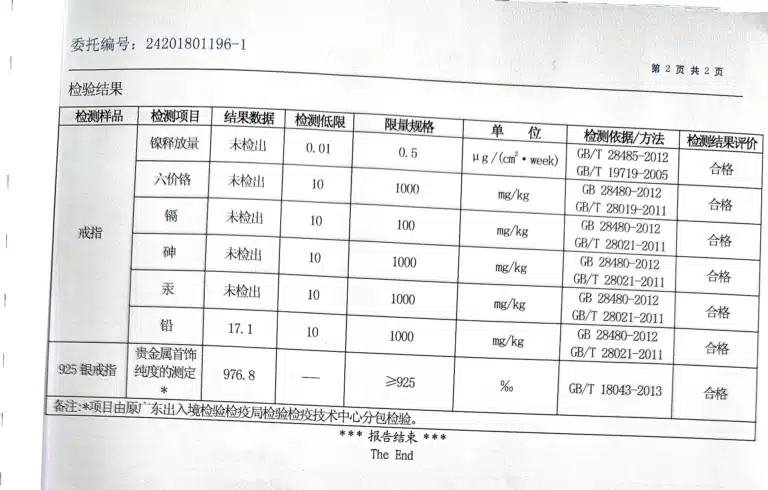
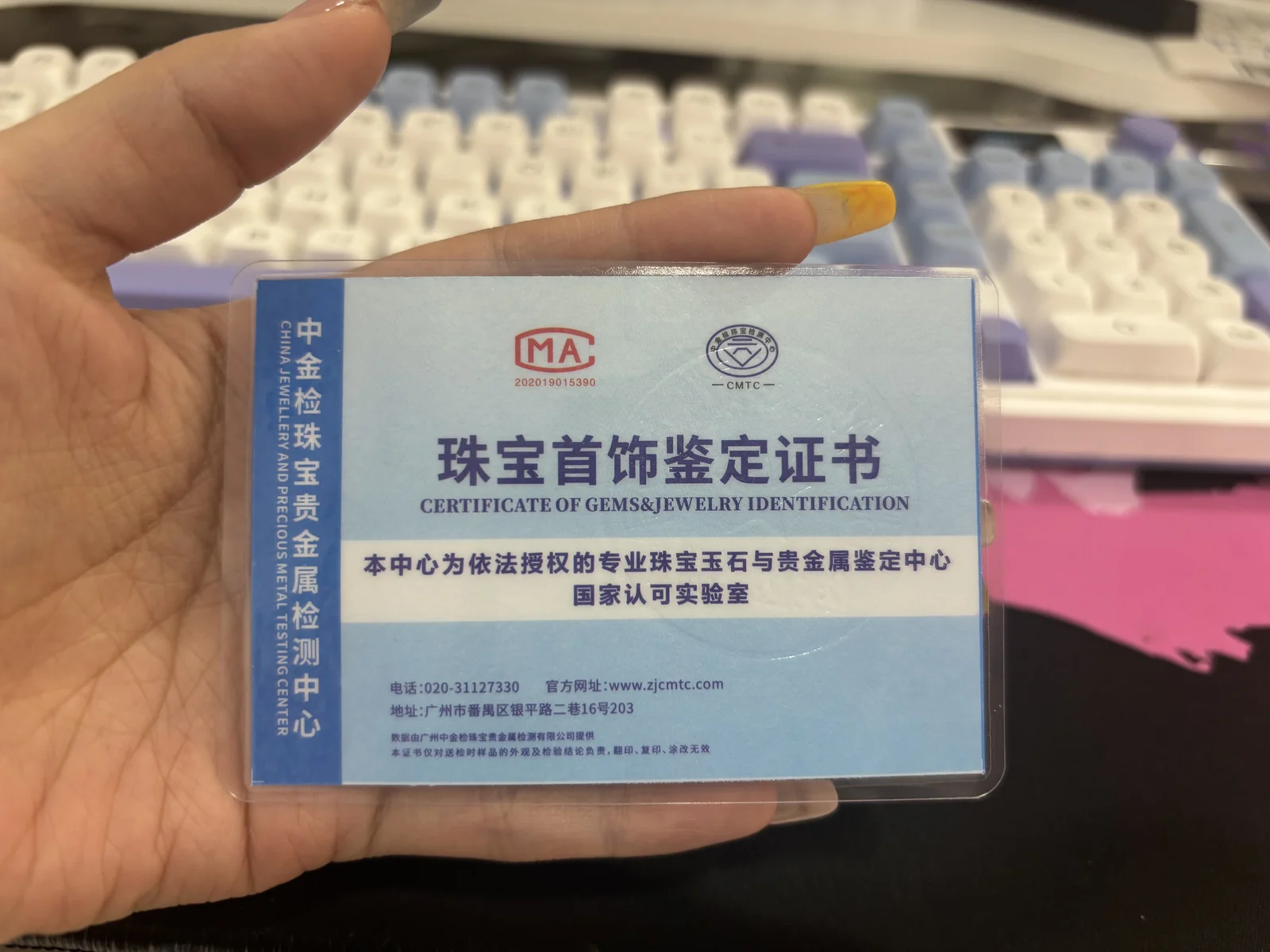
At Amara Jeweiry, documentation is part of the production record. Our published third-party assay report No. 24201801196-1 was run to GB 28480-2012, and our CMA number is No. Z212412928083. Amara has been based in Shenzhen since 2010 and uses AQL 2.5 inspection plus a 100% claw check and pull test. Ask for the report pack on the certifications page before you place the order. If you are sourcing, the wholesale moissanite jewelry และ เครื่องประดับโมอิสซาไนต์สั่งทำ pages are the next stop, and you can also check our FAQ.
FAQ: S925 assay tolerance and claims
Is 91.8% silver inside the 4/1000 tolerance for an S925 mark?
No. Four parts per thousand below 925 is 921. A 918 result is 7/1000 below the mark and 3/1000 beyond the allowance. If the lab tested a solder-free sample, the result supports a claim.
Is 91.8% inside the solder allowance?
Yes, if the assay covered the entire article including solder. Ten parts per thousand below 925 is 915, and 918 is 3/1000 above that floor. The report must say solder was included; the number alone does not establish it.
What if the ring has no solder?
Then the whole-item allowance does not apply. The 921 floor governs the piece, whether the lab calls it a whole-ring assay or a body assay. A 91.8% result is out of tolerance.
What if the report says 92.0%?
On a solder-free sample, 920 is still 1/1000 below the 921 floor, so it is out of tolerance. On a whole-item soldered assay, 920 is above 915 and passes. The sample description, not the round number, decides the case.
Can a lab’s measurement uncertainty make 91.8% acceptable?
Uncertainty affects how confident you can be in the value; it does not change the legal floor. If the uncertainty band crosses 921 or 915, the report is borderline evidence. A referee fire assay is the practical way to resolve it.
Does the 4/1000 rule apply to a ring marked “S925” rather than “sterling”?
Yes. S925 is industry shorthand for 925/1000 silver. The mark shows a fineness of 925, and the statute ties the tolerance to the fineness shown by the mark. A 900 “coin” mark would produce different floors; for S925, they are 921 and 915.
Is this legal advice?
No. This article explains the assay arithmetic and the documentation needed for a commercial claim. For a legal or regulatory question, consult counsel in the relevant jurisdiction.
The practical rule is simple: 91.8% is a claim only when the lab tested a solder-free portion, or when the ring has no solder at all. When the lab tested the whole soldered article, 91.8% is inside the allowance. Read the sample description first; the percentage comes second.