







Yes — your factory stays accountable to you, because outsourcing the plating changes who performs the work, not who owes you conforming goods. Your purchase order binds the factory; the factory’s own subcontract binds the plating workshop; and privity of contract means you cannot claim against, or compel, a workshop you never contracted with. But accountability that exists only on paper is worth little after a failed batch, so the real question is what you required before production: a named and pre-approved plating subcontractor, batch-by-batch EN 1811 test reports tied to lot numbers, sealed retained samples for independent retesting, and a witnessed-audit right — or a three-way confidentiality agreement when the plater refuses direct access. EN 1811 itself will not give you any of this; it defines a test method and limits, not supply-chain duties. You have to write those four things into the contract yourself, before the first plated batch is made.
My Factory Sends Plating Out to a Separate Workshop: Who Is Accountable When the Batch Fails EN 1811?
The factory. That answer surprises buyers who expect a legal chain to mirror the production chain, but contract law runs on privity: a contract creates obligations only between the parties who signed it. Your purchase order was signed with the factory, so the factory owed you goods that meet the specification you bought — including the nickel-release requirement, whether you wrote “REACH entry 27 compliant”, “EN 1811 tested” or simply “nickel-free” into it. The factory’s choice to have a separate workshop do the electroplating is a fact about its supply chain, not a defense against your purchase order.
This matters because the disclosure usually arrives late: either the factory names the workshop during onboarding, or a batch fails and the factory explains that plating “was not done here”. Either way your rights are unchanged — the factory’s recourse is against its subcontractor, yours is against the factory. What outsourcing does change is evidence: the bath logs, strike-layer records and process parameters that explain a failure sit in a building you have no right to enter. That is why the rest of this article turns accountability from a legal principle into clauses you can enforce.
What Does an EN 1811 Failure Actually Tell You?
It tells you the goods exceeded the nickel-release limit measured by the reference test method — no more and no less. EN 1811 is the European standard reference method for nickel release, tested in artificial sweat and used to demonstrate compliance with the EU nickel restriction; the limits it is read against are 0.5 µg/cm² per week for articles in direct and prolonged skin contact, and 0.2 for piercing articles (see this peer-reviewed summary of nickel-release testing). The number tells you where the goods stand against that line — not why.
Why does outsourced plating make the failure harder to diagnose?
Because every handoff destroys context, and a plating subcontract adds the most destructive one. Nickel release on a plated silver piece can originate in the plating shop — a contaminated bath, a nickel-bearing strike layer, an under-specified coating — or in a final coating applied back at the factory after the goods returned. With plating in-house, one company holds every record; with it outsourced, the factory holds assembly and QC records, the workshop holds process records, and neither has an automatic duty to hand anything to you. So before arguing causes, require the paperwork: which EN 1811 version the lab cited (our FAQ cites the harmonized EN 1811:2023 method; an older version on a report is worth questioning), which lot the samples came from, and whether they were drawn from the delivered batch or an untraceable lab run.
Flow-Down Clauses: What to Put in the PO Before the First Plated Batch
The standard gives you limits; only the contract gives you someone to enforce them against. Since your rights stop at the factory, the clauses in your purchase order must push your requirements down to its subcontractor — that is what “flow-down” means. Four clauses cover nearly everything a plating-failure dispute needs.
1. Name and pre-approve the plating subcontractor
State in the purchase order either the exact plating workshop the factory must use, or a pre-approval condition: the factory discloses the workshop, submits its qualification documents — a documented quality-management system, plating credentials, its own EN 1811 track record — and obtains your written approval before your goods are plated there. Add a change-control line: no substitution and no moving your work to a second bath without written notice and your consent. Without it, a factory can quietly move your order to a cheaper bath between orders, and you find out when a report stops matching the goods.
2. Require a batch-by-batch EN 1811 report tied to the lot
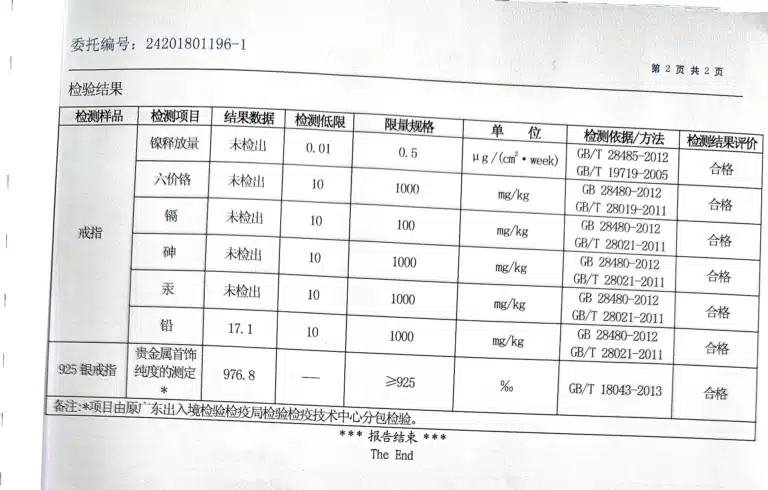
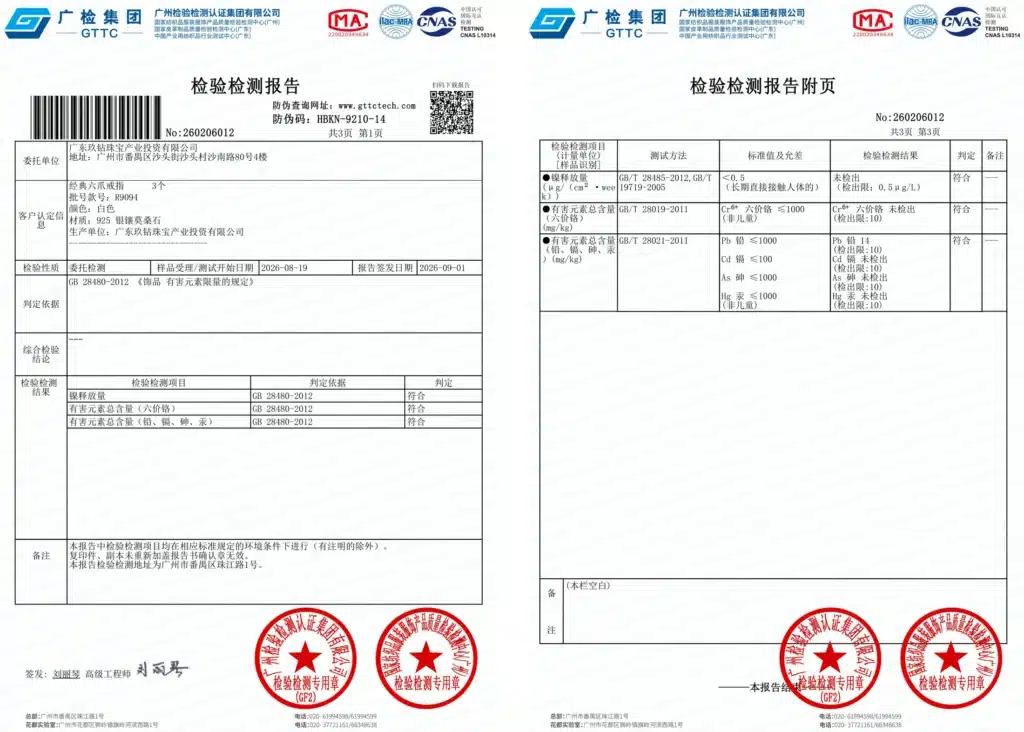
One certificate “for the process” proves nothing about your batch. Specify that every production lot ships with a report from an accredited laboratory stating the method and version used, the lot identification, the test date and the result — and that the report travels with the goods. Publishing third-party results read against the REACH nickel limits and letting reports travel with the shipment is the pattern on our own certifications and test-report page; the useful habit is the linkage, because a report that names your lot is evidence, and one that does not is decoration.
3. Retained samples, sealed and lot-coded
Require the factory to retain, for every plated lot, two samples drawn from that lot and coded with its number: one sealed intact as a retention standard, one available for destructive testing. This borrows the logic of a good pre-production sample versus production run protocol: the sample that matters is one made under the same bath, on the same day, as your goods. Retained samples make disputes solvable: when a batch fails months later and the factory insists the plater’s bath was in control that week, an independent lab retests the sealed sample and turns two opinions into one measurement. Agree the retention period in writing before the first order.
4. Write the audit right — and the three-way NDA fallback
Ask for a witnessed-audit clause: the right, on reasonable notice, to visit the nominated plating workshop with the factory’s quality staff and review the process records for your lots. Then accept that plating shops often refuse direct buyer access, because bath formulas and line parameters are trade secrets. The standard compromise is a three-way confidentiality agreement — buyer, factory, plater — under which you may audit while the plater’s formulas stay redacted; where even that fails, a third-party inspection firm witnessing the audit on your behalf is the accepted substitute. Never accept a factory that refuses all three in writing — that is the configuration where you learn about failures from the factory’s summaries of the plater’s summaries.
Can I Audit the Factory’s Plating Subcontractor Directly?
Not as of right — you have no contract with the workshop, so you cannot compel entry, and a plater who has never heard of you can turn you away at the door. Make the audit happen through the clauses above, in one of three forms. First, the contractual route: your audit clause obliges the factory to arrange and accompany the visit. Second, the substitute route: a tripartite NDA or a third-party inspection firm performs the witnessed audit where direct access is refused. Third, the documentary route: even without walking the line you can audit on paper — bath-control logs, rinsing records, per-lot EN 1811 reports, the plater’s quality documents. Walking the floor is how an audit stops being paperwork; the video below shows the kind of production-floor walkthrough such an audit covers.
When travel is impossible, require the remote equivalent: a recorded batch walkthrough before balance payment, the pattern described in our guide to the batch video we send before balance payment. A video does not replace a lab report, but it ties faces, floors and lot labels to the paperwork — exactly what a chain with a subcontractor otherwise lacks. And start every audit conversation with the quality system itself: a documented system lets a factory and plater show records rather than opinions.

If I Am the EU Importer, Where Does the Legal Duty Actually Sit?
Closer to you than most buyers assume. The EU nickel restriction applies to articles placed on the European market, and for goods you import, the operator placing them on that market is you. EN 1811 allocates no blame inside your supply chain; it is a measurement method, and the workshop abroad that plated your goods usually owes no duty to you or your customers — its duties run to the factory that hired it. So the market-facing exposure of an EN 1811 failure lands on the importer, while the ability to fix the process sits two contract links away. Flow-down clauses close that gap: they convert your unenforceable position against the plater into an enforceable position against the factory. Discovering this hierarchy in the purchase order costs nothing; discovering it in your first recall conversation costs plenty.
The Batch Already Failed — What Now, and in What Order?
First, freeze: quarantine the lot, keep every carton, report and label, stop shipping the affected SKUs. Second, demand the factory’s evidence pack: the workshop’s identity, the process records for your lots, and the batch EN 1811 report — its absence is itself a finding if your PO required one. Third, retest: send a sealed retained sample to an independent accredited laboratory, stating the method and version. Fourth, settle the remedy on paper: who replates or replaces, at whose cost, against which claim window — the reasoning in our guide to who pays for plating defects applies almost unchanged, because a compliance failure is the strongest claim a factory can face. Fifth, corrective action before the next order: root cause at the workshop, a corrected bath or coating, requalification of the first lot.
FAQ: Outsourced Plating and EN 1811 Accountability
Does the factory’s “the plating is done by a third party” disclaimer ever hold up?
Not against your purchase order. Unless you agreed in writing to buy goods plated by a named third party on that party’s terms, the factory remains the only party you contracted with, and the subcontract is its risk-management decision, made without your signature. A disclaimer can still weaken you quietly if it sat in the factory’s standard terms and you accepted them unreviewed — one more reason the four flow-down clauses belong in your document, not just theirs.
Who pays for the EN 1811 retest after a failure?
Whatever the contract says, so say it. The workable default: the factory pays when the independent retest confirms the failure, the buyer pays when it confirms the goods pass, and the governing result is the accredited laboratory’s report on the retained sample — not either party’s internal certificate. That one sentence prevents the stalemate where both sides wait for the other to book the lab.
Is EN 1811:2023 the required version, or can a supplier still cite EN 1811:2011+A1:2015?
Check, then pin the answer in the PO. Standards are revised, and a report citing an outdated version can understate release rates or miss scope changes your market cares about. Ask your laboratory and your target-market compliance adviser which version they expect, then require that exact version designation on every batch report. We cite the harmonized EN 1811:2023 method in our FAQ; your clause should name whichever version your market and lab accept.
How is this different when the factory plates in-house?
The chain shortens to one company and most of this article becomes unnecessary: no undisclosed workshop, bath records and batch reports under the same roof that assembled your goods, and one audit visit covering the plating line and the QC bench in the same day. That is how we run plating on our own S925 moissanite production — in-house, with third-party test results published rather than summarized. If your factory outsources plating and resists every clause here, comparing its answers with an in-house plater’s tells you which supply chain you would rather defend in a compliance dispute.