





Short answer: the EU’s PFAS restriction under the Packaging and Packaging Waste Regulation (PPWR) targets food contact packaging, so a jewelry box, an anti-tarnish paper insert or a foam cushion is not directly banned by that clause. You can still owe disclosure, though: under REACH Article 33, any packaging component containing a Candidate List substance above 0.1% by weight carries a duty to pass information down the supply chain. Most published guidance — including ECHA’s own PFAS material — covers food contact packaging and never addresses formats like yours. This article fills that gap with the concrete declaration file to demand from your packaging supplier and the REACH and PPWR checkpoints that actually apply to jewelry packaging.
Why EU Buyers Are Suddenly Asking About PFAS in Jewelry Packaging
Two regulatory tracks are converging on your packaging, and neither was written with jewelry boxes in mind.
The first is the PPWR — Regulation (EU) 2025/40 — which replaced the 1994 Packaging Directive and governs all packaging placed on the EU market regardless of material. It has been in force since 11 February 2025 and applies from 12 August 2026. The second is the REACH-based work on PFAS as a class: a restriction proposal submitted by five national authorities (Denmark, Germany, the Netherlands, Norway and Sweden) is under evaluation by ECHA, with transition periods ranging from roughly 18 months to 12 years depending on the use group — and proposals at this stage can change substantially.
Against that backdrop, EU buying teams have added PFAS and Candidate List questions to their supplier onboarding forms — including for the box, pouch and insert that travel with your rings. Authoritative answers about non-food-contact packaging are thin: ECHA’s PFAS and Candidate List pages are frequently unreachable, and the PPWR commentary online overwhelmingly discusses food contact packaging. That is the gap this article fills.
Does the EU PFAS Restriction Cover Jewelry Boxes? What the PPWR Actually Says
The European Commission’s packaging waste page describes the PPWR’s substance rules in one sentence: “Minimising substances of concern, including restrictions on PFAS in food contact packaging if they exceed certain thresholds.” Read that precisely.
- Scope of the regulation: the PPWR covers all packaging placed on the EU market, whatever the material. Your rigid two-piece box, your mailer, your poly sleeve and your foam insert all sit inside its general scope — which is why its recyclability, labelling and phase-in dates matter to you even though you sell jewelry, not food.
- Scope of the PFAS clause: as described by the Commission, the PFAS restriction bites in food contact packaging that exceeds defined thresholds. A jewelry box is not food contact packaging. Neither is an anti-tarnish paper strip, a velvet-lined insert or a foam cushion.
So the direct answer is: no, the PPWR PFAS ban does not directly cover jewelry boxes today. But three caveats keep this on your desk. First, the food contact PFAS restriction applies from 12 August 2026 — the date buyer questionnaires will be rebuilt around. Second, REACH disclosure duties already apply to packaging components now, with no waiting period. Third, if the universal PFAS restriction under evaluation is adopted as proposed, it would cover articles broadly — including packaging — after transition periods. A compliance file built now survives all three scenarios.
What REACH Article 33 Requires for Jewelry Packaging
REACH duties attach to packaging because packaging is an “article” under REACH — a manufactured object whose shape determines its function, just like the ring inside it. Three mechanisms matter:
- Article 33(1) — the supply chain information duty. If an article you supply contains a substance on the Candidate List of substances of very high concern (SVHCs) above 0.1% weight by weight, you must give your customer enough information — at minimum the substance’s name — to allow safe use of the article, on request and free of charge. In a B2B jewelry chain, this duty runs from the packaging manufacturer to you, and from you to your buyer.
- Article 7(2) — the notification duty. An EU producer or importer of an article containing an SVHC above 0.1% w/w in quantities over one tonne per year must notify ECHA, unless exposure during all use phases can already be excluded. If you import packaging components into the EU yourself, this can reach you directly.
- SCIP notification under the Waste Framework Directive. Articles containing SVHCs above 0.1% w/w placed on the EU market must be notified to ECHA’s SCIP database. As a working rule, packaging supplied with your product follows the jewelry article’s notification, while packaging placed on the EU market in its own right — boxes sold separately as gift packaging, say — is separately notifiable. Confirm your exact configuration with your EU responsible person.
One structural point bites hardest in practice: the 0.1% threshold is assessed per article as produced. Your foam insert is a different article from your rigid box — and a lot lighter, so a few grams of a fluorinated treatment in a 30-gram foam block crosses 0.1% far more easily than in a 400-gram gift box. Weight the threshold component by component.
The PFAS Due-Diligence File: What to Demand from Your Packaging Supplier
Because no published EU guidance tells you what “compliant jewelry packaging” paperwork looks like, you have to define it contractually. This is the file to specify. None of it substitutes for legal advice; all of it is what a serious EU buyer will eventually ask to see.
- A component-by-component material declaration. Every part listed separately: box board, covering material, hinge, magnet, foam or EVA insert, anti-tarnish paper, poly bag, adhesive, printing ink, varnish and any laminate. A single-line “paper box, PFAS-free” certificate is worthless — PFAS hides in the coating and the glue, not in the board.
- A dated Candidate List (SVHC) declaration per component. Whether each component contains any Candidate List substance above 0.1% w/w and, if so, its name and CAS/EC number — citing the Candidate List version checked, refreshed after each ECHA update.
- A PFAS-specific statement for the highest-risk components. For anti-tarnish papers, grease- or water-repellent papers, foams, textile linings, adhesives and anything PTFE-coated: an explicit “no intentionally added PFAS” statement plus total fluorine data where the supplier has it.
- Test reports, not just statements. Where the supplier’s own data is thin, require total organic fluorine screening by combustion ion chromatography from an accredited laboratory, with method, limit of detection and sample date stated. There is no EU test mandate for non-food-contact packaging today — set your own contractual limit.
- Coating and process declarations. Release coatings, mold-release agents and certain plating baths for metal hinges have historically used fluorosurfactants. Confirm the processes used, not only the substances purchased.
- A PPWR readiness statement. Which PPWR obligations the supplier is tracking for your formats, and on what dates.
- A change-notification clause. Any reformulation, coating change or sub-supplier switch triggers a re-declaration before the next shipment. Without this, a declaration is a photograph of the past.
- Traceability that matches your PO. Component IDs on the declarations should match the SKUs you order, so the paper trail maps to the carton when a buyer audits you.
- A signed and dated declaration of compliance referencing REACH Article 33 and the PPWR by name, on company letterhead. An unsigned PDF is not a document you can put in front of a buyer’s compliance team.
Your Compliance Calendar: REACH and PPWR Checkpoints That Actually Apply to Jewelry Packaging
- Now: REACH Article 33 duties already apply to any packaging component containing an SVHC above 0.1% w/w. There is no grace period and no jewelry exemption. If you cannot answer a buyer’s Candidate List question about your foam insert today, that is the gap to close first.
- Every six months, roughly: ECHA updates the Candidate List, and each update can pull a new substance into scope. Calendar a 30-to-60-day re-declaration cycle after each update, applied to documents 2 and 3 above.
- 12 August 2026: the PPWR applies and Directive 94/62/EC is generally repealed. New declarations should cite the Regulation, not the old Directive, so you are not re-papering in a year.
- 12 August 2026: the PPWR’s PFAS restriction for food contact packaging takes effect. It does not directly cover jewelry boxes — but it is the date retail compliance systems will be rebuilt around, and being ahead of it is cheap now and expensive then.
- Ongoing, date unconfirmed: the universal PFAS restriction proposal under ECHA evaluation. If adopted as proposed, it would extend to articles including packaging after transition periods of roughly 18 months to 12 years depending on the use. Treat every published timeline as provisional.
The Three Components Where Jewelry Packaging Actually Goes Wrong
Anti-tarnish and grease-proof papers
Historically, some anti-tarnish and grease-resistant papers relied on fluorinated treatments for water and oil repellency. This is the most likely PFAS touchpoint in a jewelry pack. Ask for total fluorine data or a signed no-PFAS statement specifically for this item — the tarnish-protection chemistry itself does not require PFAS.
Foam and EVA inserts
Inserts carry surface treatments and, in some supply chains, flame retardants — and their low weight makes the 0.1% w/w threshold easiest to cross here. This is where an unweighed “the box is fine” assurance falls apart: declare the insert as its own article.
Magnets, hinges and plated metal fittings
Small metal fittings involve plating processes, and certain baths have historically used fluorosurfactants. A process-level declaration (document 5 in the file) is the only realistic cover, because the fitting itself will never be lab-tested at jewelry packaging volumes.
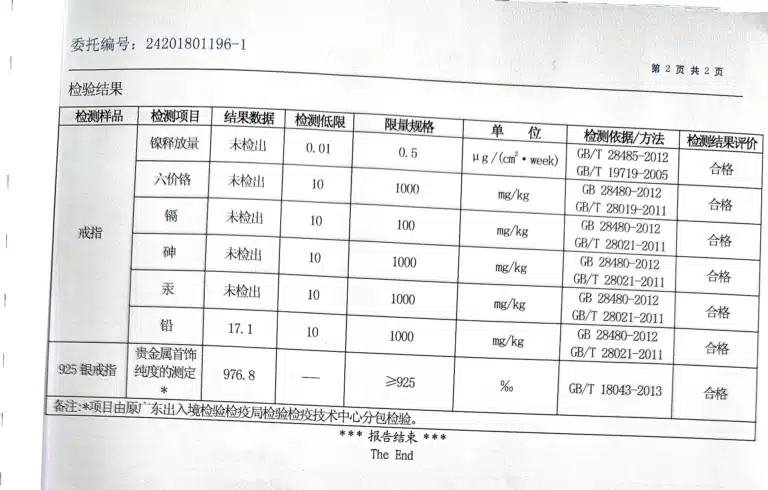
At Amara Jeweiry, packaging for OEM and wholesale orders is part of the private-label service — our certifications page shows how we document the jewelry article itself, from nickel release to REACH screening, and our guide to packing silver for humid sea containers covers what travels around it. When you brief any supplier on private label packing, make the declaration file above part of the written specification, not a verbal assurance.
FAQ
Is jewelry packaging subject to REACH at all?
Yes. Packaging is an article under REACH. When a packaging manufacturer supplies boxes to you, they owe Article 33 information for any SVHC above 0.1% w/w; when you supply the packed product to an EU buyer, the duties continue down the chain. The jewelry article and its packaging are assessed separately.
Do I need to test my jewelry boxes for PFAS right now?
There is no EU requirement to test non-food-contact packaging for PFAS today. Testing is a commercial due-diligence response: buyers ask, and a total organic fluorine screen on your two or three highest-risk components is the cheapest credible answer.
What if my packaging supplier refuses to declare?
Treat the refusal as information: you cannot demonstrate compliance for that component, so either qualify a second supplier or make the declaration a condition of purchase in your PO. Refusals cluster among traders who do not control the mill or the coating line — go one tier up the supply chain.
Does the 45-day REACH window apply to buyer questionnaires?
Article 33(2) gives consumers the right to SVHC information within 45 days of a request, free of charge. B2B buyers will contractually demand faster answers — which is why the file needs to exist before the questionnaire arrives.
Will the universal PFAS restriction eventually ban jewelry boxes?
If the proposal under evaluation is adopted with its current article-based scope, packaging would be covered after transition periods, with derogations varying by use group. The scope, thresholds and dates are not final and have already been revised during ECHA’s evaluation. Build your declaration file now; make purchasing changes when the restriction is adopted.
The Bottom Line
The PPWR’s PFAS clause is aimed at food contact packaging and does not directly ban anything in a jewelry box — the Commission’s own page makes that clear. What keeps packaging on your compliance desk is REACH Article 33, which has applied to articles including packaging for years and asks a question the published PFAS material never answers for your formats: what is in the box, per component, above 0.1%? The nine-document file above, refreshed on the Candidate List cycle and anchored to the 12 August 2026 PPWR application date and the Commission’s Article 5(5) evaluation deadline of 12 August 2030, is the practical answer — and exactly what an EU buyer’s onboarding form is asking for when it says “PFAS declaration for packaging.”