







Short answer: no exemption takes S925 sterling silver jewelry outside the Section 301 China lists. Additional duties on Chinese goods are defined per 10-digit HTS code, not per product category, and most jewelry codes were swept into the 2019 trade actions like other consumer goods. The figure you should expect behind most silver jewelry codes is the 7.5 percent additional rate tied to the September 2019 tranche — yet sourcing blogs currently quote totals from 7.5 percent to 42.5 percent for the same product, and a CBP ruling often cited in those posts, N306666, would not open for us, so we could not verify it. The reliable fix is a ten-minute self-check against the official tariff schedule for your own 10-digit code, which we walk through step by step below.
Does Section 301 actually apply to S925 silver jewelry?
Section 301 of the Trade Act of 1974 let the Office of the United States Trade Representative impose additional duties on goods from China after its 2018 investigation into technology transfer and intellectual property practices. USTR implemented those duties in four tranches by trade value — the $34 billion, $16 billion, $200 billion, and $300 billion trade actions listed on its tariff actions page — and every tranche is written at the subheading level of the Harmonized Tariff Schedule.
That is where buyer confusion starts. There was never a rule about “jewelry” as a category: each 10-digit HTS line either appears in a USTR annex or it does not, and the additional duty that applies is whatever Chapter 99 heading references that code. So the real question is not “does Section 301 cover S925 silver jewelry” but “which code describes your piece, and which Chapter 99 line currently attaches to it.” Articles that skip that step produce the contradictory totals circulating online.
Why do online quotes for the same silver jewelry range from 7.5% to 42.5%?
Where 7.5% comes from — and how we verified it
The 7.5 percent figure traces to published notices. USTR’s August 20, 2019 notice (84 FR 43304) imposed an additional 10 percent duty on roughly $300 billion of Chinese goods, split into Annex A (effective September 1, 2019) and Annex C (December 15, 2019); the August 30, 2019 notice raised the rate to 15 percent, and the December 18, 2019 notice suspended Annex C. After the Phase One agreement, USTR published the January 2020 modification notice (85 FR 3741) reducing the additional duty “from 15 percent to 7.5 percent” for Annex A products, applicable as of February 14, 2020. Its annex replaced “15 percent” with “7.5 percent” in U.S. Note 20(r) and changed heading 9903.88.15’s rate column accordingly. We re-checked the live schedule on October 30, 2026 through the USITC’s official HTS search: heading 9903.88.15 still carries the 7.5 percent additional rate, while 9903.88.16 — the List 4B lines — is shown as suspended.
Where 42.5% comes from
The 42.5 percent figure is different in kind. No single Chapter 99 line we could find prints 42.5 percent, and we could not locate any official page stating that total for a silver jewelry code. It reads like a stack: a Section 301 layer (for example, the 25 percent carried by headings such as 9903.88.02 for List 3 codes) plus additional duties imposed under other, later legal authorities, each with its own Federal Register notice. One widely shared sourcing blog states silver jewelry sits on List 3 at a combined total near 42.5 percent; a freight-forwarder’s tariff guide puts the same product on List 4A at about 25 percent. Both cannot describe the same 10-digit code at the same time — a code appears either in a 25 percent annex or in the 7.5 percent annex, and the subheading text decides, not the blog. Stacked totals also go stale the moment any layer changes.
Why no authority has “settled” the number for you
Because none is needed. Coverage follows automatically from classification: CBP does not adjudicate “jewelry” as a class, importers or their brokers classify each product, and duties follow the code. Classification rulings cover specific products, and the ruling most often cited in these discussions, N306666, would not render its text for us on CBP’s rulings site (the page served only the site footer), so we cannot tell you what it decided. Our advice: do not build a landed-cost model on a ruling you have not read yourself — pull it, or request a binding classification ruling from CBP before committing to pricing.
How to check the current Chapter 99 rate for your own 10-digit code
Step 1: pin down your 10-digit HTS code
Sterling silver jewelry lives in one of two candidate families. Treated as jewelry of precious metal, it falls under heading 7113, where 7113.11 covers articles “of silver, whether or not plated or clad with other precious metal.” If the stones are treated as driving the article — a value comparison between metal and stones can matter — the piece may classify under heading 7117 as imitation jewelry, where 7117.19 covers base-metal articles. That determination is fact-specific and belongs to you and your customs broker. What we can show is what the classification is worth, using rates pulled from the official HTS search during this writing session: under 7113.11, chains and similar articles in continuous lengths (7113.11.10.00) carry a 6.3 percent general rate, jewelry valued not over $18 per dozen pieces (7113.11.20.00) carries 13.5 percent, and other silver jewelry (7113.11.50.00) carries 5 percent; under the imitation heading, 7117.19.90.00 carries 11 percent. The base rate alone varies by more than 8 points — before any additional duty stacks on.
Step 2: search the code in the official HTS tool
Go to hts.usitc.gov, the U.S. International Trade Commission’s official HTS search, and enter your 10-digit code (or the 6-digit heading to browse). The statistical suffix matters: the three 7113.11 lines above differ only in their last digits, and the general rate is not the same on all of them. Results show the full line text, the general (Column 1) rate, special program rates, and related Chapter 99 provisions — when we searched 7117.19 for this article, the results page surfaced a Chapter 99 provision attached to 7117.19.90, which shows exactly how the tool connects a merchandise line to its tariff-action provisions.
Step 3: read the Chapter 99 lines and trace them to the notices
Search “9903.88” and you get the Section 301 heading map, which we pulled for this article. The structure is worth learning once: 9903.88.01 through 9903.88.04 carry the 25 percent additional rate for codes under earlier U.S. notes 20(a) through 20(g) — the Lists 1, 2, and 3 tranches; 9903.88.15 carries 7.5 percent for notes 20(r) and 20(s); 9903.88.16, the List 4B lines, is suspended; and a long run of exclusion headings shows the base duty only, many time-limited — some active windows in the current schedule run “through November 9, 2026,” days away from this article’s date. Find which U.S. note 20 subdivision cites your 10-digit code; the tranche tells you the rate. Every line traces to a Federal Register notice readable on govinfo.gov — the one linked above is a single page.
Step 4: put the number in your landed-cost sheet, then re-check each order
The arithmetic is simple once the lines are right: the Chapter 99 additional duty stacks on the Chapter 71 base rate, ad valorem, on the entered value of the article. As a worked example only — not a quote — a silver jewelry line with a 5 percent general rate plus the 7.5 percent additional rate costs 12.5 percent of entered value in duty (5 + 7.5 = 12.5); the same invoice budgeted with a stacked 42.5 percent figure carries about three and a half times that duty load (42.5 ÷ 12.5 = 3.4). Which budget you build changes sourcing decisions, which is why the check matters. Two habits keep it honest: confirm code and rates with your licensed customs broker before first entry, and re-run the Chapter 99 search before every purchase order — exclusion windows open and close, and rates move by Federal Register notice, not by season.
What the rate range means for an S925 moissanite order
Everything above applies to what we ship daily: 925 sterling silver jewelry set with moissanite, made in-house in Shenzhen’s Shuibei jewelry belt since 2010 — CAD design, 3D wax printing, micro-pavé setting, plating, and QC under one roof. When you request a quote for tennis chains, pendants, rings, earrings, or bracelets, ask us for the HS code we declare on the commercial invoice and run the four-step check yourself. Comparing factories? Insist that each one states its declared 10-digit code: quotes that differ by 35 “duty points” are almost always quoting different codes or different vintages of news, not different metals.
Origin, not the seller’s nationality, drives Section 301: goods that are the product of China are covered wherever you buy them, and re-forwarding through a third country does not change origin unless the goods genuinely undergo substantial transformation there. Transshipment to dodge duties is customs fraud, not a sourcing strategy — reputable factories say so plainly, and so do we.
How Amara supports the customs side of your order
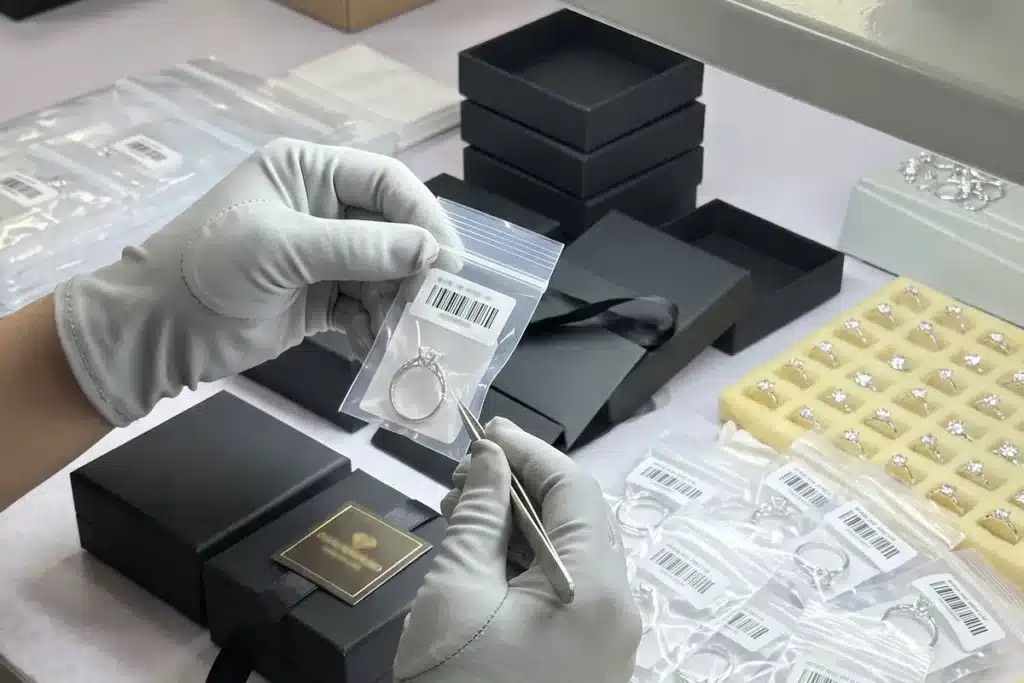
We cannot decide your classification — that is your broker’s job — but we make the paperwork checkable. Our commercial invoices carry the declared HS code, silver content, and stone description; production is ISO 9001-certified in-house, with GRA-certified moissanite and REACH/CPSIA test reports per shipment. Before balance payment you receive a batch video of your actual goods, and if your launch calendar is tight we can split the order so part ships on schedule — see our split-order production schedule. Standard terms for reference: MOQ 30–50 pieces for wholesale, 50–100 pieces for full OEM/ODM, samples in 7–10 days, bulk in 15–25 days.
If you are planning a new program, start with our OEM/ODM custom jewelry service or the برنامج الجملة, and check our buyer FAQ for production and shipping basics. Then run the tariff self-check above on the exact code we declare — checkable paperwork plus your own verification is the only version of this answer that survives the next Federal Register notice.
FAQ
Is any silver jewelry excluded from Section 301?
Exclusions exist, but they live at the statistical-subdivision level and they expire. The current schedule carries dozens of exclusion headings in the 9903.88 series that show the base duty only, many with explicit windows — some active ones in the schedule we pulled run through November 9, 2026. Treat exclusions as code-specific and time-boxed: search your exact 10-digit code, read the line, and note the dates.
Is 7.5% still the rate today?
For codes in the September 2019 tranche (U.S. notes 20(r) and 20(s), heading 9903.88.15), the live HTS still printed the 7.5 percent additional rate when we checked on October 30, 2026. But rates change by Federal Register notice, and your code determines whether that heading applies at all — so verify your code in the official search before each order rather than assuming the number stands forever.
Should I just budget 42.5% to be safe?
Over-budgeting feels safe and is usually wrong in practice: if your true total is near the base rate plus 7.5 percent, budgeting 42.5 percent can kill an otherwise profitable program or push you to a higher-cost country unnecessarily. The disciplined version of “safe”: pull the current lines for your code, add a buffer percentage you choose, and have your broker confirm at entry — a defensible number with a stated margin, not a blog figure with no traceable source.
Does the additional duty hit only the silver content?
No. Section 301 duties are ad valorem on the entered value of the article as classified — the finished jewelry’s customs value, not a metal-content subset. This is also why classification matters so much for moissanite-set pieces: the same design can land on different lines depending on how the article is classified, and the applicable base rate differs by line.
If my supplier ships from outside China, does Section 301 disappear?
Only if the goods are genuinely the product of that country. The duties apply to articles the product of China; origin follows where goods are grown, produced, or manufactured, and merely re-forwarding Chinese-made goods through another territory does not change it. Genuine substantial transformation can change origin, but that is a legal determination, not a logistics choice, and CBP penalizes transshipment designed to evade duties. Get your broker’s sign-off on the supply chain before you sign the purchase order.