



eBay’s Authenticity Guarantee does cover sterling silver moissanite rings — eligibility is decided by category and price, not by whether the stone is a natural diamond. Fine jewelry listed at $500 or more is authenticated at no cost for eligible items, while jewelry priced $200 to $499.99 can be enrolled through an optional add-on costing $40 per item plus applicable tax, paid at checkout. eBay publishes no option below $200. GIA, the Gemological Institute of America, performs the inspection: it verifies metal type and purity — sterling silver must test at 925 or higher — and confirms the stone is the material your listing claims it is. What it does not do is grade or value the piece. eBay states that the jewelry service results include no valuation, grading, or appraisal of any item.
What eBay’s Authenticity Guarantee Actually Is
Authenticity Guarantee is eBay’s independent verification program for selected categories, including fine jewelry. For jewelry, eBay collaborates with GIA. Eligible items are routed to an authentication facility before the buyer receives them, where experts perform what eBay’s program pages describe as a multi-point inspection and check the piece for accuracy against the listing. Items that pass ship with a card or tag confirming authentication; items that fail are never delivered, and the buyer is refunded.
Two price tiers apply to jewelry. At $500 or more, the service is complimentary for eligible listings — eBay covers the cost of authentication and the expedited shipping from the authentication facility to the buyer. Between $200 and $499.99, authentication becomes an opt-in add-on: eBay’s seller program page states that for jewelry priced between $200 and $499, the cost to add the Authenticity Guarantee service on qualifying items is $40 per item plus applicable taxes, applied at checkout. eBay’s buyer help article lists the same $40 fee for qualifying jewelry in that range. One eBay marketing page still displays $20 for the same tier, so treat the fee shown at checkout as the governing number. Shipments valued at $1,500 or more require a signature on delivery, and international buyers pay a $35 charge for the international shipping leg.
Does a Sterling Silver Moissanite Ring Qualify — or Is It Natural Diamonds Only?
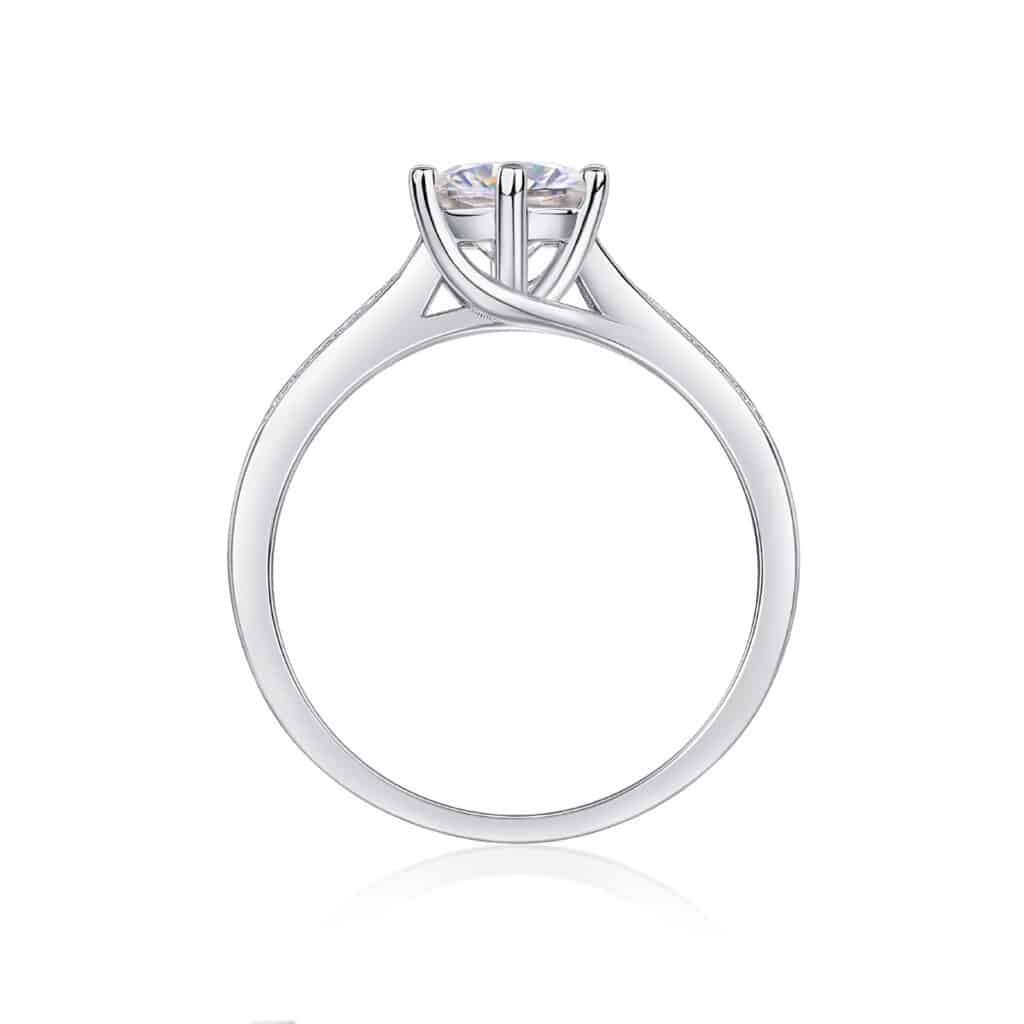
Nothing in eBay’s published jewelry program restricts Authenticity Guarantee to natural diamonds. The eligibility language refers to eligible jewelry and qualifying items, defined by category and price band. The inspection itself is built for mixed materials: it examines logos, tags, materials, hardware, and condition, and verifies the item against the listing description. A sterling silver moissanite ring listed in eBay’s fine jewelry category therefore qualifies the same way a gold diamond ring does — once its price lands in one of the two tiers.
How the inspection treats a 925 silver setting
eBay’s jewelry program page lists the purity floor the inspection applies: sterling silver at 925 or higher, gold at 9K or higher, palladium at 500, platinum at 850. That number maps directly onto the regulatory meaning of the mark. Under the FTC’s consumer guidance, the words silver, sterling, and sterling silver describe products that contain 92.5% pure silver, and silver products are sometimes marked 925, meaning 925 parts per thousand are pure silver. A setting stamped and described as 925 is therefore squarely within what the authenticator verifies: the metal should test at or above that purity, not merely look white and shiny.
How the inspection treats a moissanite stone
Moissanite is not a diamond, and the program does not pretend otherwise. GIA’s own gemological literature describes colorless synthetic moissanite as pure silicon carbide whose high hardness, second only to diamond, and thermal conductivity make it a convincing diamond simulant. That is precisely why listing accuracy matters here. The inspection verifies that the stone in the ring is the material the listing names. A listing that says moissanite must be moissanite — not cubic zirconia, not glass, and not a diamond. If your listing claims a natural diamond, the inspection tests that claim and a moissanite stone will fail it. If the listing honestly declares moissanite, the service protects that declaration for the buyer and shields the honest seller from “not as described” disputes.
Mapping the $500 and $200–$499.99 Thresholds to Real Sterling Silver Moissanite Prices
The two thresholds cut the silver moissanite ring market into three practical bands, and the economics of the material explain why the lowest band matters most. Sterling silver settings and lab-created moissanite exist precisely to deliver a diamond look at a fraction of diamond pricing — that is the product’s core value proposition, and it is why volume manufacturers such as Amara Jeweiry, a Shenzhen-based 925 silver moissanite specialist operating in the Shuibei jewelry belt since 2010, build wholesale and OEM programs around it. The corollary for eBay sellers: entry-level, small-stone silver moissanite rings are expected to price far below the $500 line, and many below the $200 floor, where Authenticity Guarantee is simply unavailable. In that band, buyer trust rests entirely on listing quality, seller feedback, and supplier-side proof — more on that below.
The middle band is where the add-on lives. Rings with larger center stones, heavier silver work, or vermeil finishes are the designs most likely to price between $200 and $499.99. There the decision becomes explicit: the buyer can add authentication at checkout for $40, and the option appears only on qualifying items in eligible categories. The top band begins at $500.00, where authentication becomes free — which creates a fee cliff worth studying:
| Listed price | Authentication | Fee as share of price |
|---|---|---|
| $199.99 | Not offered | — |
| $249.99 | $40 add-on | 16.0% |
| $349.99 | $40 add-on | 11.4% |
| $449.99 | $40 add-on | 8.9% |
| $499.99 | $40 add-on | 8.0% |
| $500.00 | Free, automatic | 0% |
A ring listed at $499.99 with the add-on costs its buyer $539.99 all-in. The same ring relisted at $500.00 with free authentication costs $500.00 all-in and delivers the same GIA-verified result — so what the cliff actually returns depends on who was paying the fee. Under the default pass-through, the seller’s proceeds barely move, from $499.99 to $500.00 — a gain of $0.01 per unit — and the real windfall goes to the buyer, whose all-in cost drops by $39.99 for an identical authenticated item. Only when the seller absorbs the fee does the seller’s own ledger improve, by roughly $40 per unit: a net of $459.99 at $499.99 becomes $500.00 at $500.00. Pricing just over the threshold is not always possible — the item still has to qualify, and buyers comparison-shop on sticker price — but every seller with a listing parked near $499.99 should run this arithmetic before letting the $40 fee be paid at all.
When Is the $40 Add-On Worth It? A Margin Check for eBay Resellers
Start with who pays. The add-on is purchased at checkout, so in the default flow the buyer opts in and pays the $40 plus tax. Your product margin is untouched, and the authentication badge works as a conversion lever on trust-sensitive SKUs rather than as a cost line. The margin question only changes when you choose to absorb the fee or bundle it into the item price:
- Pass-through (default). The buyer pays $40 at checkout. No margin impact; the trade-off is that a price-sensitive buyer sees a higher all-in total than an identical listing without authentication.
- Absorb the fee. On a $300 ring carrying a 30% gross margin ($90 per unit), a $40 fee consumes roughly 44% of that margin. Absorbing makes sense only where authentication demonstrably lifts conversion or measurably cuts returns — a single avoided return on a $300 ring costs far more than the $40 fee.
- Reprice across the cliff. As the table shows, $500.00 converts the $40 paid service into a free one. If the design can carry $500, this dominates absorbing the fee on a $499.99 listing.
Below $200 the calculation disappears, because there is no Authenticity Guarantee to buy at any margin. That is why the supplier-side checklist in the next section carries the entire trust load for entry-level silver moissanite rings.
What Gets Verified on a 925 Moissanite Ring — and What Doesn’t
What the GIA inspector confirms
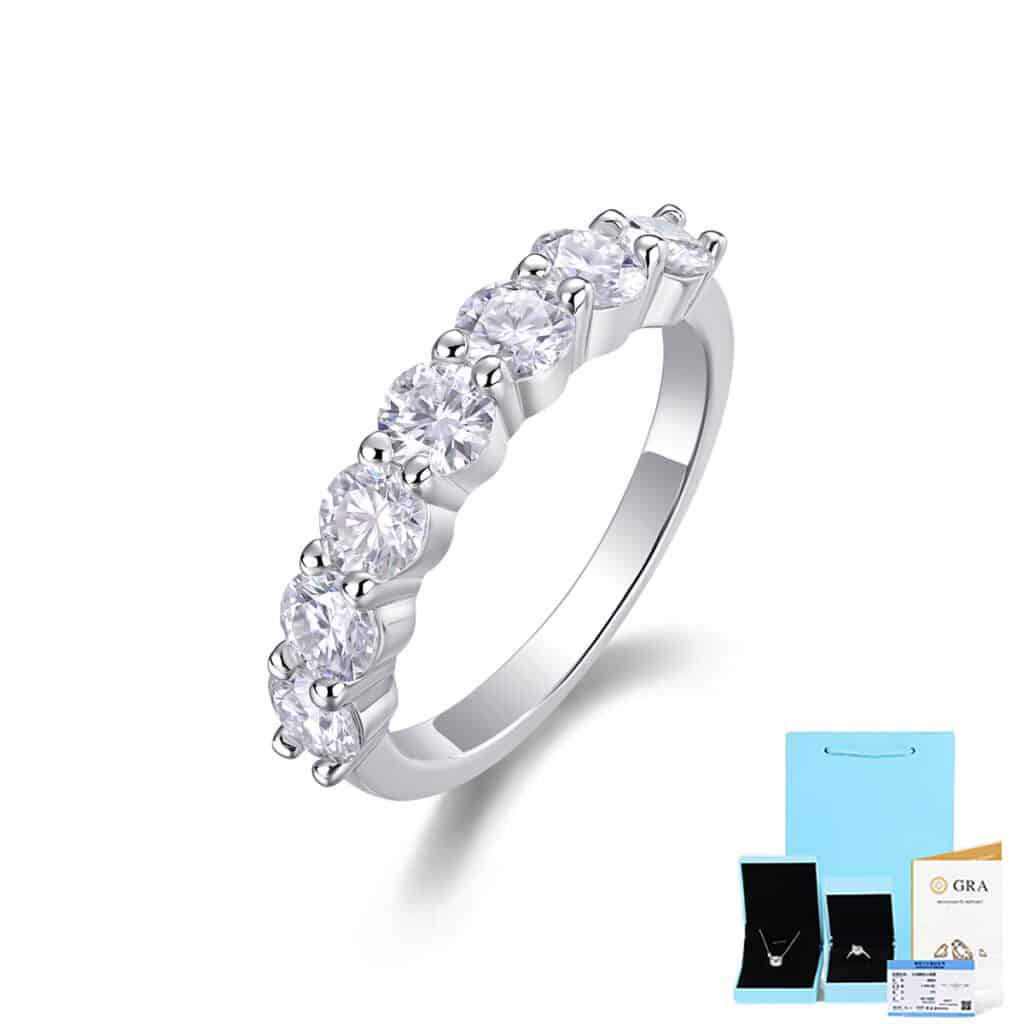
Per eBay’s program terms, the authenticator checks that the item matches the listing description and performs a multi-point inspection covering metal type, purity, and gemstone quality, along with logos, tags, materials, and hardware. For a 925 moissanite ring that means: the metal tests at the sterling floor of 925 or higher, the stone is identified as the material the listing declares, and the complete piece matches what was advertised. When a buyer returns an authenticated item, the experts also verify the returned piece is the same item in the same condition it was sent in. Packaging and accessories are inspected too, which is why gift-box presentation is not cosmetic for an eBay seller.
What the service does not cover
The boundaries are equally explicit, and moissanite sellers should memorize them:
- No grading or appraisal. eBay states that the results of the Authentication Services for Jewelry do not include valuation, grading, or appraisal of any item. Your moissanite receives no cut, color, or clarity grade from the service — there is no 4Cs report to reuse in your listing.
- Only GIA certificates are authenticated. Most set and loose moissanite ships with a GRA-style identification card; Amara’s published specifications, for example, describe GRA-documented D/VVS1 moissanite with laser-inscribed girdles. Authenticity Guarantee will not verify those cards — eBay’s terms reserve certificate authentication for GIA certificates, and other certificate details go unchecked.
- Detection limits. eBay’s jewelry terms acknowledge that testing may not always determine whether a stone is laboratory-grown or has been treated. The service is an authenticity check against the listing, not a full gemological report.
- Not a QC report. Authenticity Guarantee inspects one sold unit, once, for identity. It does not measure plating thickness, test color-fastness after months of wear, or audit consistency across a wholesale batch — the checks an import buyer actually needs. It cannot substitute for a supplier QC program.
Building Buyer Trust Below the AG Threshold: The Supplier-Side Checklist
For resellers sourcing wholesale moissanite jewelry — Amara’s ready-to-ship designs start at 30 to 50 pieces — trust signals have to come from the supply chain rather than from eBay’s program. The published checklist worth copying from Amara Jeweiry’s materials: third-party assay of the silver (the company cites GB 28480-2012 testing showing Silver 976.8 per mille), laser-inscribed girdles on its D/VVS1 moissanite, AQL 2.5 inspection before shipment, and a 12-month color-fastness warranty with free stone re-setting. Ask any prospective manufacturer for a batch video of your actual goods before releasing the balance payment — that is batch-level evidence Authenticity Guarantee will never provide. Review the certifications page and the buyer FAQ before committing, and if your eBay line is built on exclusive designs, the OEM/ODM custom jewelry service explains how private-label specifications become listing claims you can defend.
The division of labor is simple: Authenticity Guarantee verifies a single transaction after the sale; your supplier documentation verifies the entire catalog before the first listing goes live. Run both, and the price threshold stops being a trust ceiling.
FAQ
Does eBay’s Authenticity Guarantee cover moissanite, or only natural diamonds?
Coverage is by category and price, not gem type. Eligible fine jewelry at $500 and above is covered free; jewelry at $200 to $499.99 qualifies for the $40 add-on. The inspection verifies the stone is what the listing declares — including moissanite, which GIA classifies as a diamond simulant made of silicon carbide.
Who pays the $40 add-on fee?
The buyer pays it at checkout by default. A seller absorbs it only by choice — and on a $300 sale that equals about 44% of a 30% gross margin, so pass-through or repricing just above $500 usually preserves more margin than eating the fee.
Will Authenticity Guarantee grade my moissanite’s cut or color?
No. eBay’s terms exclude valuation, grading, and appraisal from the jewelry service. No grade is issued for any stone, moissanite included, and no report is issued that you can reuse in a listing.
Does the service verify a GRA certificate?
No. Only certificates issued by GIA itself are authenticated under the program. The GRA-style cards that accompany most moissanite are not checked, so do not present one as program-verified in your listing.
My silver moissanite rings sell for $120 — can I get Authenticity Guarantee?
No. eBay publishes no option below $200. At that level, trust comes from listing quality, seller feedback, and supplier-side proof: assay reports, batch videos, inscribed girdles, and written warranty terms.
Does Authenticity Guarantee prove the silver is really 925?
Yes. The jewelry inspection applies a sterling floor of 925 or higher, matching the FTC definition of sterling silver as an alloy of 92.5% pure silver. Understand the scope, though: that is a purity check on one unit in one transaction, not a metallurgical audit of your supplier’s production line.