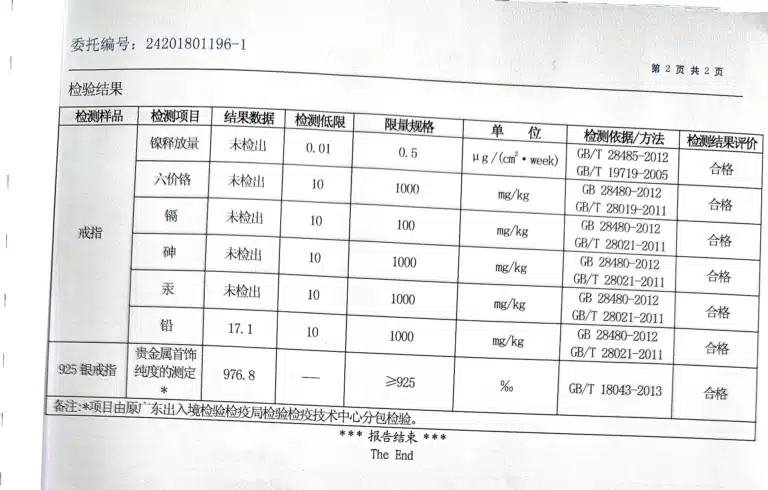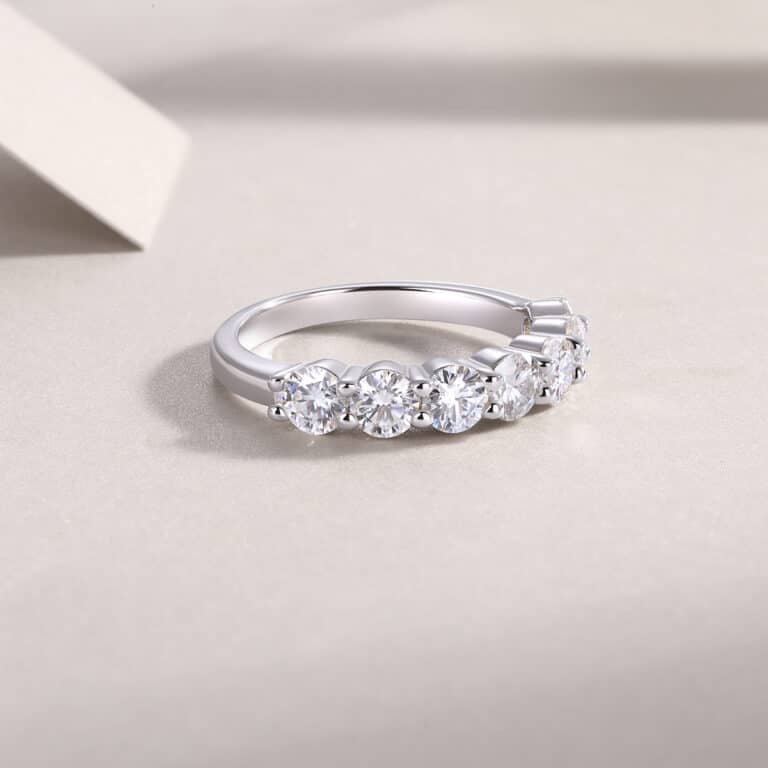








Yes, you can ask, and a capable factory can honor it — but factories reliably honor only what the purchase order defines, not what an email hopes for. For 925 sterling silver moissanite jewelry, “run my reorders on the same line” must be written as five checkable clauses: the same casting line with named mold and cavity numbers; the same plating bath solution held at a fixed rack loading density; side stones drawn only from the same allocated parcel, with no cross-batch mixing of moissanite or cubic zirconia; finished pieces compared against the sealed golden sample under one defined light source for plating color; and any line or bath change forcing a fresh pre-production sample, re-approved against that sealed sample before bulk work resumes. A verbal promise will not survive peak season; a numbered clause will.
Can a buyer really request the same production line for reorders — and will the factory honor it?
You can request anything; the question is what converts the request into an obligation. In jewelry manufacturing, obligations come from the purchase order, not from goodwill. Your approved first batch left behind the only assets that make a reorder look identical: the mold and its cavity numbers, the casting parameters, the plating bath chemistry, the stone parcel, and the sealed retention sample. A factory honors a same-line request when the PO names those assets and ties payment or acceptance to them, exactly the way the EN 1811 subcontractor accountability clause set ties plating quality to named workshops and written change control.
Do factories actually honor it? Serious ones do, and some say so publicly — Amara Jeweiry, an S925 silver moissanite manufacturer in Shenzhen’s Shuibei hub since 2010, states that its samples and bulk orders run on the same line, and publishes reorder lead times of 10–15 days on that basis. But even a willing factory cannot honor a vague sentence during a busy month. When capacity forces a substitution — a different casting line, a freshly rebuilt bath, a new stone parcel — an uncommitted supplier will quietly switch and hope you do not notice. A committed supplier must instead disclose the change and ask, because your clause says so. That difference in behavior is the entire point of writing it down.
What does “same production line” actually mean in an S925 silver jewelry factory?
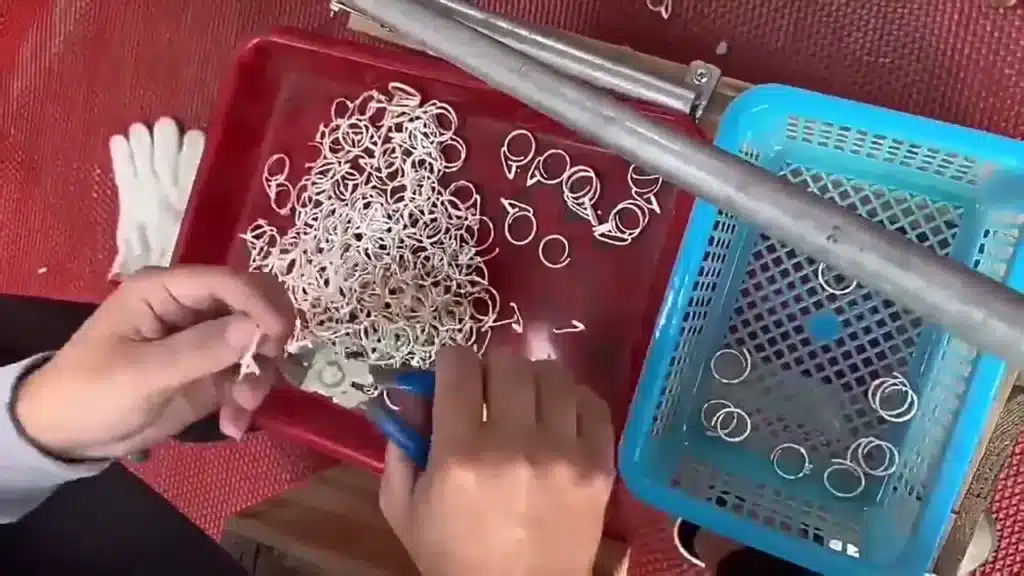
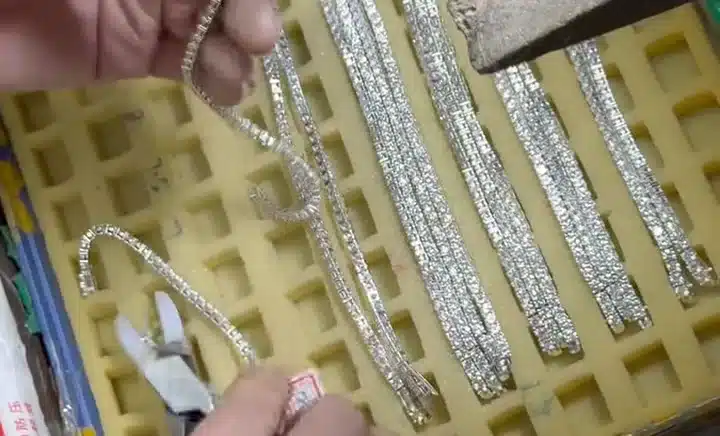
Silver jewelry does not flow down one continuous line like bottles on an assembly belt. A batch passes through distinct stations — wax injection and casting tree assembly, setting benches, polishing, plating, and final QC — and “same line” is shorthand for keeping each station’s resources identical to the first batch. Before you write any clause, the video below shows what those stations look like in practice: a setter finishing a pavé bangle at a bench, pliers closing links on tennis chains laid out in a production tray, a flame soldering repair under a task light, and polishing under extraction.
Watch how each stage is a separate bench with its own tools and operator, because every one of those benches is a place where a reorder can quietly drift away from your approved batch if it is routed somewhere new.
Your contract therefore needs station-level identifiers, not the phrase “same line.” The five clauses below do that, and each one is written so it can be verified with evidence rather than trust.
Which five clauses lock reorder consistency into the purchase order?
Clause 1 — Same casting line, same mold and cavity numbers
Specify the casting line by identifier, and the mold by mold number and cavity number. As the team explains in the pre-production sample guide, cavity-to-cavity variation is real: pieces cast from different cavities of the same mold can differ in weight, and pieces from a different mold entirely can differ in stone seat positions, even when photos look the same. Your clause should read that the reorder must be cast from the approved mold and cavity set recorded in the first batch’s approval document, and that any replacement — a recut mold, a new cavity insert, a different casting machine or tree configuration — requires written buyer consent before wax injection. Weigh a few cast pieces against the first batch’s recorded weight tolerance rather than trusting the label on the bag.
Clause 2 — Same plating bath solution and the same rack loading density
Plating is where reorders most visibly drift: rhodium that looked bright white on batch one arrives faintly yellow, or 18K gold vermeil reads a half-shade paler. Two levers cause this. First, the bath itself — its chemistry ages, and a bath topped up, rebuilt, or replaced between batches plates a different color. Your clause names the bath by ID and forbids switching baths, or rebuilding the existing one, without written consent. Second, and less obvious: rack loading density. The same tank plates differently depending on how many pieces hang on a rack and how far apart they sit, because spacing changes the effective current reaching each surface — denser racks can shade recessed areas and thin the deposit exactly where it matters, on prong edges and clasp tongues. Write the rack configuration into the PO: the same rack type, the same pieces-per-rack count, and the same hanging positions used for the approved batch. Amara publishes a minimum of 2.5 microns of gold for its 18K vermeil over recycled 925 silver, so for vermeil reorders, add that thickness must be re-measured per batch, not assumed from the first run’s report.
Clause 3 — Side stones from the same allocated parcel, never mixed across batches
“D color VVS1” is a grade, not a parcel. GRA-certified moissanite matches within the grade, but different production lots of stones — even from the same supplier — sit at slightly different positions inside the color and cut ranges, and a pavé face mixing two parcels shows it as a patchy shimmer no single certificate can explain away. The clause states that all side stones for the reorder must come from one allocated parcel, reserved and logged for your SKU, and that no stones may be topped up from any other parcel to fill a shortfall without written approval. If any piece in your program uses cubic zirconia accents, the same parcel rule applies to them — the failure mode is identical. For centers, record the GRA certificate numbers of reference stones in the approval document so reorders can be matched against them; Amara’s stones are laser-inscribed on the girdle and queryable in GRA’s database, which makes parcel-level traceability practical rather than aspirational.
Clause 4 — Plating color compared against the sealed sample under one defined light source
This is the clause that catches the drift clauses 1–3 prevent. Specify that finished reorder pieces must be compared side by side with the sealed golden sample under a single defined light source — a standard light booth, not a workshop wall at noon — because daylight mixed with fluorescent shop light makes two different platings look identical and two identical platings look different. Visual color comparison against a reference panel under controlled illumination is a recognized measurement approach, standardized for coatings in ISO 3668:2017, the international standard for visual comparison of colour of paints and varnishes; the same discipline transfers directly to plated silver. Write down the light source, the viewing angle, and the acceptable verdict: no visible difference at arm’s length, or a stated tolerance if you use instrument readings. Insist the comparison happens before packing and that a photo of the sample and the reorder piece together, under that light, ships with the batch — the same evidence discipline as the batch video taken before balance payment.
Clause 5 — Any line or bath change triggers a new pre-production sample
Consistency clauses fail silently unless they define what happens after a change. The clause: if the factory must cast on a different line, use a different or rebuilt bath, load racks differently, or open a new stone parcel, production stops until a fresh pre-production sample is made under the new conditions and re-approved against the sealed golden sample — compared under the same light source as clause 4, on the same terms as the original approval. Note that a sealed golden sample without lot references is, as Amara’s own guidance puts it, a nice piece with no authority; your sealed sample should carry the lot references recorded at first-batch approval, so the re-approved comparison actually binds the new run to the old one.
So do factories honor these clauses in practice — and what happens when they cannot?
They honor clauses they can schedule, and they escalate clauses they cannot — which is exactly the behavior you want. When a reorder PO arrives with named mold, bath, rack, and parcel identifiers, production planning either reserves those resources or tells you there is a conflict while you can still choose: wait for the original bath to be available, accept a new-bath run gated by a re-approved pre-production sample, or split the quantity. What no buyer should accept is discovering the switch after delivery, when the only recourse is a plating defect claim and an argument about who pays for re-plating. A well-written clause flips that: the change requires consent first, so the cost of a substitution is negotiated before it happens, not litigated after. Factories with in-house casting, setting, electroplating, and QC — the vertical setup Amara describes from CAD through packing under its ISO 9001 system — honor these clauses more easily than assembly-trade workshops, because they control the resources instead of renting them.
Frequently asked questions
Does a same-line clause cost extra or slow the reorder down?
Usually neither, when the factory controls its own line: reserving the same mold, bath, and parcel is scheduling discipline, not added work, which is why Amara can hold reorder lead times of 10–15 days and an MOQ from 30 pieces for stock designs. Costs appear only when you force a change — a new pre-production sample after a bath rebuild, for example — and a fair PO assigns that cost to whoever requested the change.
What if the original mold or line is retired by the time I reorder?
The clause chain handles it: retirement is a change, changes require written consent, and consent triggers a new pre-production sample re-approved against your sealed sample. If the mold is gone, re-cutting it becomes part of the change request, and the re-approval comparison under one light source is what protects you — not nostalgia for the old equipment.
Is this different from the pre-production sample I already approved for the first batch?
Yes. The first approval proved the design could be produced; a reorder approval proves the new run matches the old run. Same document structure — mold and cavity numbers, bath ID and thickness, stone parcel references, light-source comparison — but every reference must point to the reorder’s actual lots, and the comparison target is your sealed retention sample from batch one. For OEM/ODM programs, Amara’s custom jewelry process keeps exclusive molds on file, which is what makes that re-approval possible years later.
What evidence should accompany a reorder shipment?
Four items, all defined by the clauses above: the light-booth comparison photo of finished pieces beside the sealed sample; confirmation of mold, cavity, bath ID, and rack configuration used; the stone parcel reference covering every piece; and the standard batch report and test documentation already part of Amara’s AQL 2.5 final inspection routine.
Who pays if the reorder plating color drifts anyway?
Whoever broke the clause. If the factory switched baths without the consent your PO requires, re-plating and re-shipping are at the factory’s cost; if you approved a change in writing, the re-approved pre-production sample becomes the new reference and the drift question disappears. Amara’s published 12-month anti-tarnish and stone-loss warranty covers defects in the ordinary sense, but the clause set above is what prevents the argument from ever opening.