








Both pricing methods are live in the S925 silver trade, and a single quotation can use both at once. The fastest way to tell which one you received is to read the unit-of-measure column on the price sheet: if each item row shows a net weight in grams multiplied by a rate per gram, the quote is per gram of finished silver; if every row carries one all-in amount per piece with no weight column, the quote is per piece. Watch for hybrids, because metal billed by the gram with labor and stones by the piece is common. Three lines decode any sheet: the UOM entry, the metal-versus-labor split, and the price-validity note, which tells you whether the rate floats with the silver market or is locked until a stated date.
Do silver jewelry factories quote per gram or per finished piece?
Both, and the choice usually follows the metal content of the product. Heavy cast items — tennis chains, cuff bracelets, signet rings, nameplate pendants — are normally quoted per gram, because silver is the dominant and most volatile cost. Light, standardized items — small stamped pendants, ear studs, earring backs, simple chain findings — are often quoted per piece, because metal barely moves the number and the labor content is stable.
The logic is simple. On a per-gram structure, the factory passes the metal component through at a transparent rate and negotiates only the making charge. On a per-piece structure, the factory absorbs metal risk inside one number and re-quotes when that risk threatens its margin. Neither is a trick; each shifts silver-price risk to a different party. What matters for you is knowing which shift you have signed up for — and that information is always on the sheet, encoded in ordinary-looking rows.
The metal rate itself is normally anchored to a benchmark rather than to a feeling. For silver, the global reference is the LBMA Silver Price, set each London business day in an auction administered independently by ICE Benchmark Administration (LBMA precious metal prices). When a quotation line says “silver at market plus premium,” this is the market it means.
Which line on the quotation tells me which method was used?
The pricing method is rarely announced at the top of a quotation. It is encoded in four places: the unit column, the arithmetic between columns, the presence of a weight column, and the validity note. The table below is a decoder for a real sheet.
| What you see on the sheet | How to read it |
|---|---|
| Unit / UOM column shows “g” and Amount = weight × rate | Per gram of finished silver |
| Unit / UOM shows “pc” with a single amount and no weight column anywhere | Per finished piece |
| A row reads “net weight 28.0 g, rate 1.10, amount 30.80” | Per gram on final net weight |
| A row reads “metal issued 30.2 g”, later “scrap returned 2.2 g — credited” | Per gram on metal issued before casting, minus returned scrap |
| “Making charge 0.65/g” versus “making charge 13.00/pc” | The labor block is priced per gram or per piece — check its own unit |
| “Price basis: LBMA silver plus premium, rate valid 7 days” | Floating per-gram rate with a refresh window |
| A weight column exists, but Amount does not equal weight × rate | Per piece; the weight is printed for freight or quality control, not priced |
Start with the unit-of-measure column
The UOM cell is the fastest tell. “g”, “gm” or “gram” means the row is priced by weight; “pc”, “pcs” or “unit” means by piece. Some sheets use “per dozen” or “per lot” — divide out to a per-piece equivalent before comparing factories. If the UOM cells differ across rows on the same sheet (metal in grams, stones in pieces, packing in pieces), you are holding a hybrid quotation, which is normal and often the most transparent format.
Then check the arithmetic between columns
Multiply across every row. If an amount only reconciles through a per-gram rate, that row is gram-priced even when the unit cell is blank or mislabeled. If it reconciles as quantity times a flat figure, it is piece-priced. One subtle variant: every row says “per pc,” yet the totals of two designs with identical labor differ in exact proportion to their weights — that factory is pricing per gram behind the scenes and rounding the result into a piece number.
Treat the validity note as part of the price basis
“Rate valid 15 days,” “silver to be confirmed at order date,” “final metal cost per actual shipment weight” — these clauses tell you where the price is frozen and where it floats. A quotation that shows per-piece numbers but carries a metal-reconfirmation clause is per piece only until the next refresh; at reorder, it behaves exactly like a per-gram quote.
Per gram of what? Net finished weight versus metal issued before casting
The per-gram factories use two different baselines, and the gap between them is worth up to the entire scrap margin. Ask which one is on your sheet.
Net finished weight is the weight of the polished, completed piece as you would weigh it on arrival. The calculation is clean: gram rate multiplied by finished weight per piece. You can audit it with a pocket scale, and it is the basis that matches the sample you approved.
Metal issued before casting is the weight loaded before polishing losses and gate scrap. A sheet on this basis carries rows such as “gross weight issued,” “scrap returned — credited at the same rate,” or a “loss factor” expressed as a percentage. This reflects the factory’s true metal consumption and can be entirely fair, but it is harder to audit from outside. The non-negotiable check: scrap must be credited at the same rate at which metal was charged, or the spread becomes a hidden cost.
Your specification data is the audit trail for either basis. When you approve a sample, weigh it, write the finished weight onto the spec sheet beside the dimensions, and reference that number in the purchase order — the same discipline a factory applies when it documents a cuff bracelet’s width and inner size for production.
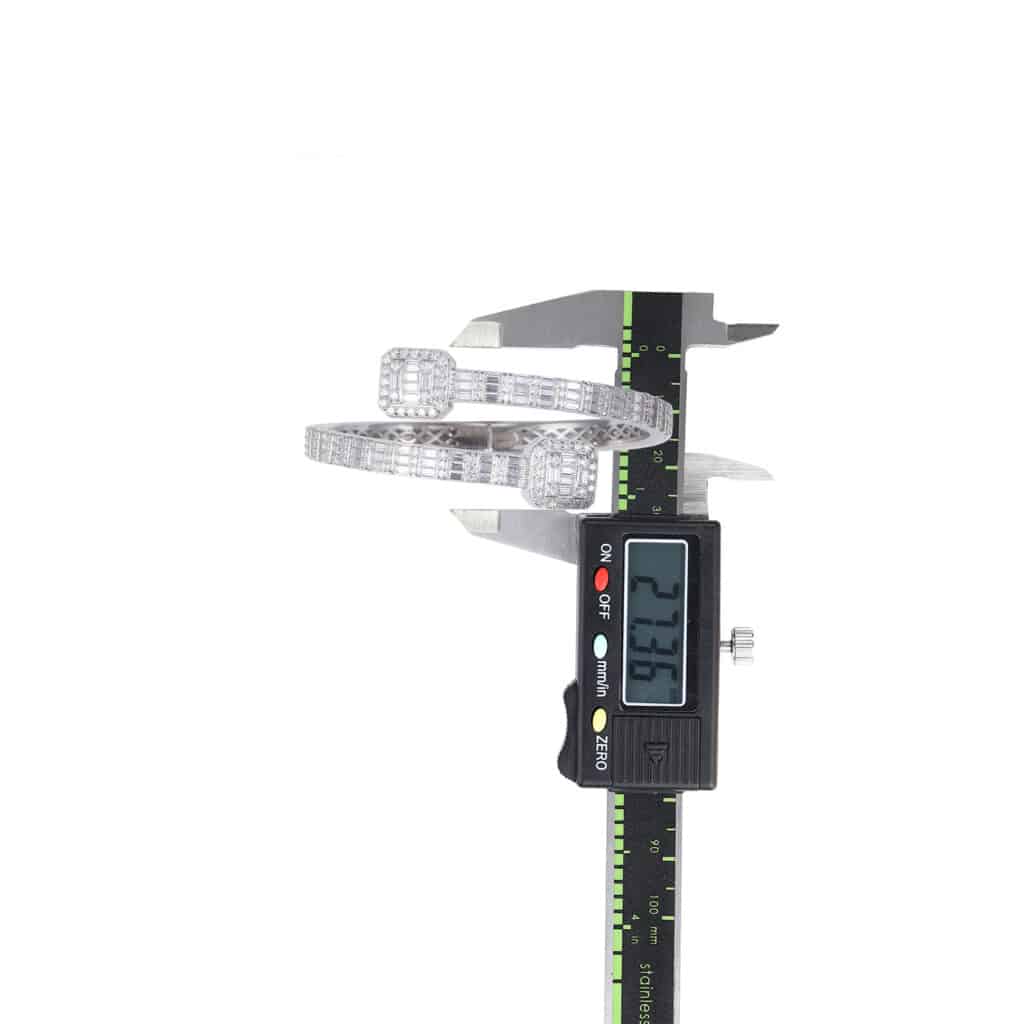
Two more lines deserve attention. “Minimum chargeable weight per pc” lets a factory bill light items at a floor weight — acceptable when disclosed, a surprise when not. And remember what the gram is made of: S925 is an alloy with a 92.5 percent fine-silver minimum, so the metal line prices the full finished alloy weight, not 92.5 percent of it.
A hybrid quotation, decoded line by line
Illustrative numbers, rounded for arithmetic only — not an offer or a price from any factory, Amara included.
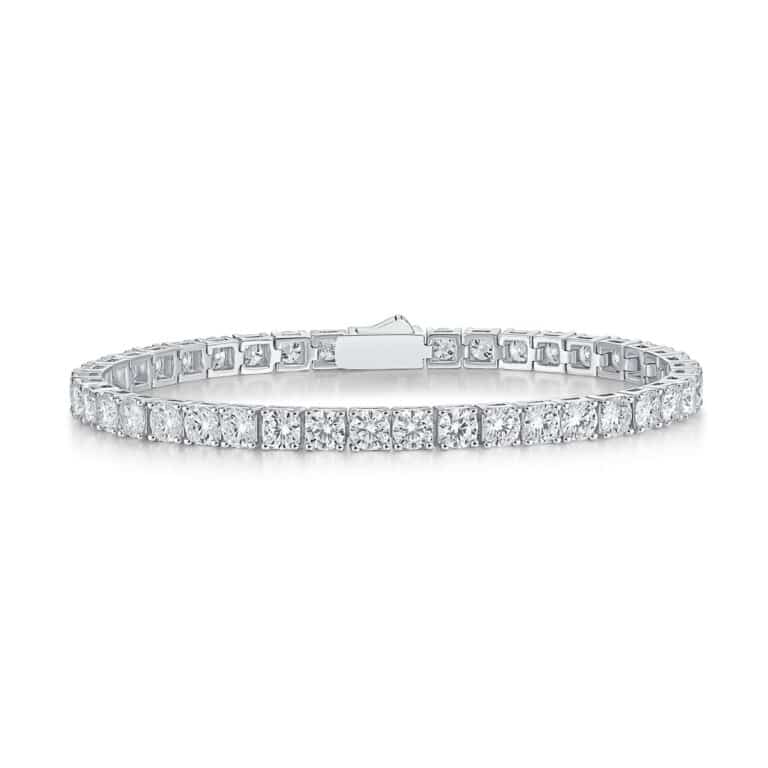
Order: 200 pieces of an S925 moissanite tennis bracelet, 19 cm, finished weight 28.0 g per piece.
| Line | Description | Basis | Quantity | Rate | Amount |
|---|---|---|---|---|---|
| 1 | Silver metal — net finished weight | per gram | 5,600 g | 1.10 | 6,160.00 |
| 2 | Making charge — casting, setting, polishing | per gram | 5,600 g | 0.65 | 3,640.00 |
| 3 | Moissanite, D color VVS1 | per piece | 200 pc | 12.00 | 2,400.00 |
| 4 | Rhodium plating | per piece | 200 pc | 0.80 | 160.00 |
| 5 | Gift box and protective bag | per piece | 200 pc | 0.50 | 100.00 |
| Total | FOB Shenzhen | — | — | — | 12,460.00 |
The decode: lines 1 and 2 reconcile only as weight times rate. Lines 3, 4 and 5 reconcile as pieces times a flat rate. One sheet, two methods — and that is the point. The all-in equivalent is 62.30 per piece, but it exists only after weight and metal rate are fixed. When this buyer asks for “your per-piece price,” the only honest answer is: 62.30 as of today’s silver and the stated weight, with the metal line moving at reorder.
The issued-weight variant of line 1 would read: metal issued 30.2 g at the same gram rate, scrap returned 2.2 g credited at the same gram rate — the arithmetic lands on the identical 30.80 per piece. When scrap is credited symmetrically, the two conventions converge; when it is not, compare sheets on net-weight terms.
Contrast the same order quoted purely per piece: one row — 200 pieces at 62.30 per piece — with the 28.0 g weight printed in a specification column for freight and control only. Same economics, different decode, and far less visibility when silver moves.
Traps that hide which method you actually got
- Quoted weight, invoiced re-weight. A clause such as “final weight per actual shipment” lets bulk pieces run heavy. Agree a tolerance band and a remedy outside it, in writing.
- Lock-point ambiguity. With the common 30 percent deposit and 70 percent balance terms, ask whether the metal rate locks at the pro forma invoice or the deposit receipt, and get the benchmark date onto the PI.
- Stones inside the gram rate. If one factory embeds moissanite in a per-gram number while another bills stones per piece, headline comparisons mislead. Compare line by line.
- Minimum chargeable weight. Studs weighing 1.1 g billed at a 1.5 g floor — legitimate only if disclosed on the sheet.
- Currency drift. Gram rates quoted in a local currency with an unstated exchange-rate assumption; ask for the rate and its date.
- Per piece with a market trigger. “All-in price subject to adjustment if silver moves beyond a set percentage” is per piece on paper and per gram in behavior.
Five questions that force the method into the open
- Is the gram rate applied to net finished weight or to metal issued before casting — and if issued, what scrap is credited and at which rate?
- Which silver benchmark and date does the metal rate reference, and until what date is the quotation valid?
- At which document does the metal rate lock — quotation, pro forma invoice, or deposit receipt?
- Are stones, plating and packaging inside the gram rate, or separate lines with their own units?
- Is there a minimum chargeable weight per piece, and what happens if bulk weight lands outside the agreed tolerance?
Close the loop physically. Weigh the approved sample, write the number into the specification, and before balance payment request a batch video with the pieces on a calibrated scale — the verification step described in Amara’s guide to batch videos before balance payment. On a split-release payment order, that video doubles as evidence that the weight you are paying for is the weight you are receiving. And because these are made-to-order programs — see Amara’s custom moissanite jewelry service — the weight column on your quotation should trace back to the approved sample, not to a catalog estimate.
Frequently asked questions
Is a per-piece quotation always safer for my budget?
It is more stable between quotation and purchase order, but it bundles metal risk inside one number, so the reorder re-prices everything. A per-gram sheet shows exactly which line moved and why, which usually shortens the reorder negotiation.
Can I ask a factory to convert one basis into the other?
Yes, and any competent sales team can do it in minutes. The more useful request is decomposition rather than conversion: ask for the per-gram breakdown behind any per-piece number so you can audit reorders yourself.
Why did my reorder price change when the design did not?
Almost always the metal line. The benchmark silver price resets every London business day, so once a quotation’s validity window expires the gram rate refreshes to market while the making charge typically holds.
Does the per-gram rate include the moissanite stones?
On a hybrid sheet, no — stones sit on their own per-piece line. On an all-in per-piece sheet they are bundled. Look for the stones row; if there is none and the gram rate looks high for plain silver, the stones are inside it.
What exactly is a making charge?
The labor block: casting, filing, stone setting, polishing, plating and assembly, quoted per gram or per piece. It is the component a buyer can negotiate; the metal line belongs to the market.
How quickly should a factory answer these questions?
Fast. Amara, an S925 silver moissanite manufacturer in Shenzhen since 2010, commits to quotations within 12 hours of an inquiry and samples in 7 to 10 days. A team with a real costing model answers unit-of-measure and weight-basis questions instantly; hesitation on those two points is itself a signal.