





Short answer: no – the caption alone is not the safe place for a lab-created disclosure on TikTok Shop. The working rule is that the qualifier travels with the claim: wherever a video says or implies “diamond,” the words “lab-created” or “laboratory-grown” (or, for moissanite, the honest noun “moissanite”) need to appear in the video itself – spoken on the audio and burned into the frame as on-screen text – and then be repeated in the caption and the listing title. One honesty note before anything else: the official TikTok Shop seller-policy page we attempted to load while writing this article timed out after ten seconds, so we will not quote a “3-second overlay” or “30-second verbal” rule we cannot verify. What you get below is the checkable path to the first-hand text inside Seller Center, plus the disclosure-placement logic of the FTC’s Jewelry Guides, which we did verify.
What TikTok Shop’s official rule actually says – and why we cannot quote it
We tried to read the rule before writing a word of this. The public seller-education page for TikTok Shop’s rule center, at seller-us.tiktok.com/university/rule-center, returned a connection timeout after ten seconds when we fetched it on 27 October 2026. That is the whole of our first-hand evidence about TikTok Shop’s own wording: it did not load. Anything we wrote in the form “TikTok Shop officially requires X seconds of overlay” would therefore be a guess dressed up as policy, and you should not buy that from us or from anyone.
Secondhand guides fill exactly this vacuum with confident-sounding numbers: a disclosure overlay held for 3 to 5 seconds, a verbal disclosure delivered within the first 30 seconds, and so on. Read those figures carefully and you will notice where they come from – they echo the disclosure conventions for paid advertising, the branded-content and paid-partnership labels that platforms impose on sponsored videos, not a product-material rule for jewelry listings. A “30-second verbal disclosure” is an advertising-credibility convention. Whether your stone may be called “diamond” at all is a different, older question with its own authority behind it.
Get the first-hand text yourself in about ten minutes:
- Log in to TikTok Shop Seller Center and open the rule center from the help or resource menu. The public-facing mirror of that page is the one that timed out for us; from inside a logged-in seller session it normally loads.
- Search the rule center for “misleading listings,” “product listing rules,” and “restricted products,” and note which results are platform-wide rules versus category-level policies.
- Open the policy page for the Jewelry and Accessories category and read the listing requirements end to end, including anything about material claims and stone descriptions.
- Open any live listing form and look at the structured attribute fields for stone type, main stone, and metal. If the platform forces those fields at listing level, the video must not contradict them – the attribute fields are the platform’s structured version of a disclosure.
- Screenshot what you find with the date visible, and file it. Category policies get revised without announcements, and a dated screenshot is the only record that survives a policy change or a dispute.
What the FTC Jewelry Guides actually require for placement
The rule text you can actually read today comes from the Federal Trade Commission, and its placement logic is exactly what a short product video needs. Under the Guides for the Jewelry Industry, it is unfair or deceptive to use the unqualified word “diamond” for anything that is not a mineral consisting essentially of pure carbon crystallized in the isometric system; laboratory-created stones that share a diamond’s optical, physical, and chemical properties may only be described with qualifiers such as “laboratory-created,” “laboratory-grown,” or “[manufacturer name]-created,” together with a clear and conspicuous disclosure (16 CFR 23.12). The Guides even police the word itself: an unqualified “diamond” also presumes a symmetrically cut stone with at least 17 polished facets.
The adjacent-and-prominent mechanics are spelled out most explicitly for colored stones: a synthetic or imitation stone may only take a gem’s name when the descriptor appears immediately preceding it, with equal conspicuousness – you cannot set “ruby” in large letters and “lab-created” in small ones (16 CFR 23.25). Read the two sections together and the video layout writes itself: the qualifier sits immediately next to the product noun, at equal visual and audible weight. “Lab-created moissanite tennis chain” in the first spoken sentence and in the first text frame – not “tennis chain” on screen with “it’s actually moissanite” mentioned once at second 25.
One distinction matters even more for moissanite sellers. The FTC’s definition of diamond is pure carbon in the isometric system; moissanite is a different mineral entirely. So the deceptive act is not a missing qualifier – it is using the word “diamond” at all. The fix is not “lab-created diamond” on a moissanite piece; it is naming the stone moissanite, every time it appears. If you want the full material story in plain English, we keep a dedicated explainer on what a moissanite ring actually is.
In the video, in the caption, or both?
Both – because each layer fails in a different way on its own.
- Caption-only fails silently. TikTok autoplays with the sound off for a large share of viewers, the caption is collapsed to two lines in the feed, and when a video is shared by direct message or re-embedded elsewhere, the caption context often does not travel with it.
- Overlay-only fails physically. On-screen text gets cropped by duets and stitches, covered by interface elements, and screen-recorded out of frame; a thin white font over a sparkling stone is the opposite of conspicuous.
- Spoken-only fails the muted viewer. A verbal disclosure nobody hears is a disclosure nobody received, no matter how clearly it was scripted.
The caption still matters: it is the one layer you also control at the listing level, and it helps the platform classify what it is showing. But it is also the layer most likely to be separated from the footage. Treat the caption as the third copy of the disclosure, never the only one.
A working layout for a 15-30 second product video
Here is the three-layer arrangement, mapped onto a timeline, that satisfies the FTC’s adjacency-and-prominence logic at every layer:
- Seconds 0-3, the hook. On-screen text at the top of the frame: “Lab-Created Moissanite – 925 Silver.” The first spoken sentence names the stone too. This is where disclosure does the most work, because a large share of viewers never reach the end card.
- Seconds 3-20, the close-ups. Keep a small persistent badge – “Lab-Created Moissanite” – inside the safe zone, top or upper-left, for the entire video. Equal conspicuousness is much easier to defend with a persistent badge than with one clever frame.
- The mid-video mention. When the voiceover compares sparkle or price, name the stone in the same breath: “moissanite gives you that look without the mined-stone price.” Adjacent, spoken, and natural – exactly how a qualification is supposed to work.
- Seconds 20-30, the end card. Repeat the full material name: “925 Silver – Lab-Created Moissanite.” If your stones carry a GRA certificate, this is where you point at it; whether the certificate itself must be shown at listing level is a separate question we take up below.
- The caption and the listing title. Start the caption with the same qualifier – “Lab-created moissanite tennis chain in 925 silver…” – before any emoji or hashtag, and make the listing title match word for word. The adjacency principle applies to the listing just as it does to the frame.
Five placements that fail in practice
- The pinned comment. A disclosure buried in a comment you pinned is a disclosure most buyers never open. Comments are conversation, not labeling.
- The last frame. An end-card-only disclosure misses everyone who swipes away at second five – which, on a feed, is a very large number of people.
- The qualified noun, unqualified everywhere else. “Moissanite” said once at second two, while the next twenty-eight seconds imply “diamond” through b-roll, music, captions, and hashtags. Implication is a claim.
- Invisible typography. A qualifier in thin, low-contrast lettering over a bright stone technically exists and legally fails – “equal conspicuousness” is the standard, not mere presence.
- The cropped duet. If you work with affiliate creators, their re-cuts will crop your overlay and keep only the footage. Put the disclosure into the spoken script and the creative brief, and audit their published videos the way you audit production samples.
If you resell at wholesale, the disclosure is yours to hand your sellers
Most TikTok Shop jewelry stores do not manufacture what they film. If you buy 925 silver moissanite at wholesale – our own catalogue runs to more than 200 designs in 925 silver moissanite, stones specified at D color and VVS1 clarity with laser-inscribed girdles, and wholesale orders start at 30 pieces through our program borong – then your resellers and affiliates are the ones speaking on camera, and the disclosure discipline has to be written into what you hand them.
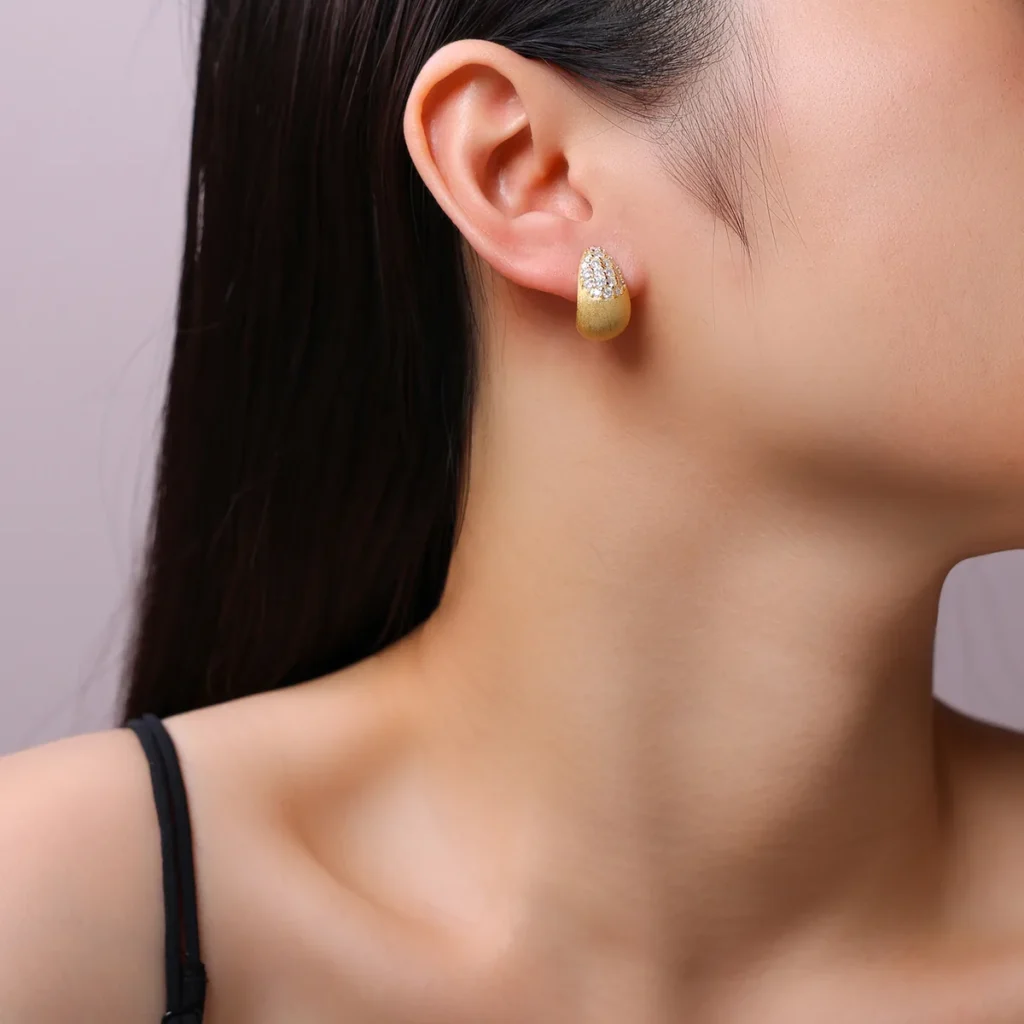
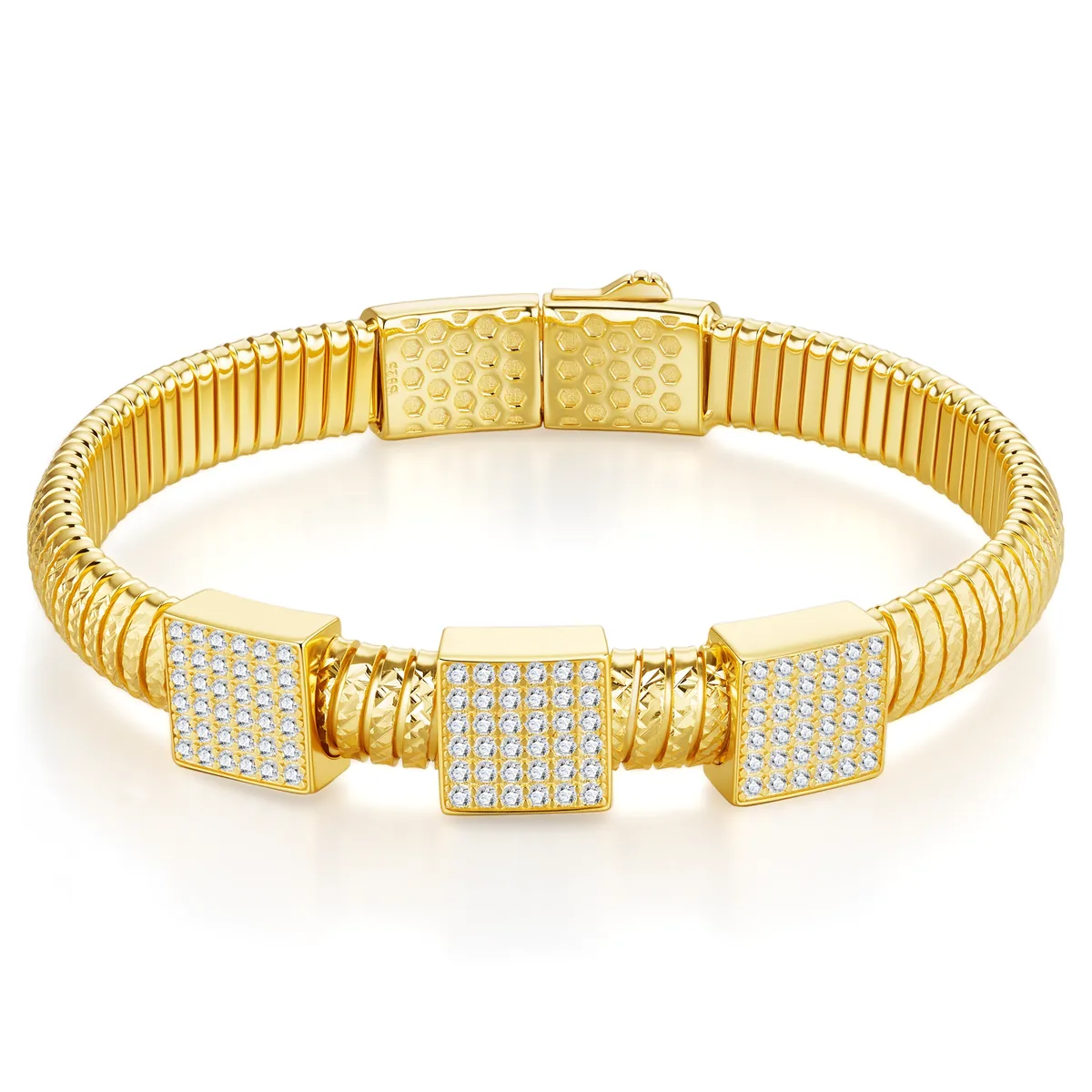
The practical move is a fixed product-naming string per SKU – metal, stone, treatment – that every script, overlay, caption, and title reuses verbatim, so each video carries the same disclosure instead of a new improvisation per shoot. The close-up below is the kind of finished piece those videos are built around.
What you can reasonably ask of a manufacturer before you scale: a written naming convention per SKU, stone specifications that match whatever the voiceover will claim, and batch-to-batch consistency so the tenth video tells the truth as plainly as the first. That is a conversation for your OEM/ODM partner, not a caption hack – it is the same discipline we apply in Shenzhen when a client’s private-label line has to survive scrutiny in the US market.
FAQ
Is moissanite a lab-created diamond?
No. Moissanite is a distinct mineral, not a carbon diamond grown in a laboratory. Under the FTC’s Guides the word “diamond” belongs to carbon crystals, so the compliant name for our stones is simply moissanite. The full material breakdown is in our explainer on what a moissanite ring is.
Does the disclosure have to be spoken, or is on-screen text enough?
Use both. Muted autoplay is the default viewing mode, so the overlay covers viewers who never turn the sound on, and the spoken line covers viewers watching hands-free or listening rather than looking. Neither layer alone survives how the feed is actually consumed.
Do I need to show a gemological certificate in the video itself?
We found no first-hand TikTok Shop text that requires it, and we are not going to invent one. The certificate question is mostly a listing-level question, which we cover in our earlier piece on whether TikTok Shop requires a certificate for moissanite rings. Treat a certificate as evidence that your disclosure is true – never as a substitute for saying “lab-created moissanite” out loud and on screen.
What wording is safest in the caption and the title?
For moissanite pieces: “lab-created moissanite,” or simply “moissanite,” placed next to the metal – “925 silver moissanite ring.” Reserve “laboratory-grown diamond” for stones that are actually diamonds. Never stack the word “diamond” onto a moissanite product with any qualifier attached, because the noun itself is the violation.
Where do I verify the current rule myself?
Inside Seller Center: open the rule center, search “misleading listings” and “restricted products,” then read the Jewelry and Accessories category policy end to end, and screenshot it with the date visible. The official page we attempted on 27 October 2026 timed out from outside the platform, which is why this article verifies the FTC’s rule text instead and treats the platform-specific placement details as something you confirm in your logged-in dashboard before you scale paid traffic.