








Yes — a half-price factory-seconds line can be a viable budget category for S925 silver and moissanite jewelry, but only after three checks that B-stock buyers in electronics or musical instruments never need to make. First, confirm the defects are genuinely cosmetic: plating that is peeling, pitted or showing base metal, and solder joints that have blackened, look like surface flaws yet worsen quickly with wear and sweat, so they are failed units in waiting rather than sellable seconds. Second, check that every 925 hallmark and engraving is intact, because the stamp is the compliance claim your customers rely on. Third, ask whether the pieces were re-polished or re-plated — reworked seconds may have left the original compliance test batch, so nickel-release (EN 1811), lead and cadmium results must be re-verified before you accept. Fail any of the three, and half price is deferred returns, not savings.
What Are Factory Seconds in an S925 Factory — and Why Doesn’t “B-Stock” Transfer?
In electronics, musical instruments and clearance goods, “B-stock” is a stable classification. The convention grades pieces on cosmetic condition while function stays intact: a dented amplifier chassis or a scuffed laptop lid remains a dented chassis for its whole service life, because painted steel and aluminium do not react with air or skin. A buyer accepts a listed cosmetic flaw, discounts it mentally, and the flaw is still exactly what it was in year five. The whole B-stock habit rests on that stability.
Plated sterling silver breaks the assumption. A finished piece is a layered system — a 925 alloy body, one or more plating layers, solder joints, prongs and stones — worn for hours against skin, where sweat acts as a mild salt-water electrolyte. In that environment a surface flaw is rarely just surface: a breach in the plating opens the base alloy to tarnish and corrosion that spread outward from the breach, and a discolored solder joint is often the visible end of porosity that keeps corroding. A jewelry defect list therefore has to be re-sorted into faults that stay put and faults that travel — and a half-price offer is implicitly priced as if every fault stays put.
Seconds come from the QC gates themselves. Ours — setting at 40x magnification, 100 percent claw checks and pull testing, AQL 2.5 final inspection — exist because those stages fail pieces: claws that lose pull testing, settings a fraction out of tolerance, plating with pits or thin spots, solder that darkened, stones with chips or weak fire. A factory that publishes a 98-percent-plus setting yield is also publishing that a few pieces in every hundred leave the line imperfect. The question is never whether seconds exist; it is whether each reject class is static or progressive.
Is a Half-Price B-Grade Line Actually Viable?
It can be, under narrow conditions. A seconds lot is worth buying when its defect classes are static and verifiable — slightly uneven stone spacing, a shallow scuff that does not breach plating, a minor polish swirl on a rear surface — and when the discount comfortably exceeds the cost of extra inspection plus a higher return allowance. Know what you are buying, too: goods you must inspect piece by piece, list honestly, and sell with disclosure.
It stops being viable the moment progressive faults dominate — peeling plating, pitting, base-metal show-through, blackened solder. Progressive faults do not cost you the discount; they cost you the returns, the reviews and the hours of triage. And if your real goal is simply a lower price point, there is a cleaner route: a ready-to-ship wholesale program at A-grade — ours starts at MOQ 30 — keeps margin without turning your team into a grading lab.
What Are the Three Silver-Specific Checks Before Accepting Seconds?
Three questions decide almost everything, and none of them appears in a typical B-stock checklist.
Check 1 — do the “cosmetic” defects stay cosmetic?
Treat four defect classes as disqualifying, whatever the price, because each looks superficial and each spreads with wear:
- Plating peeling or flaking. Plating lifts at edges and claw tips first; once a flake starts, flex and friction enlarge it. The exposed rim of base alloy tarnishes faster than the surrounding surface, so the visible flaw grows every week the piece is worn.
- Pitting and porosity. Pits in plating are pores, and pores hold sweat. The electrolyte sits against the base metal and corrosion works outward from the pit — a pinpoint today, a black weeping spot after a month of wear.
- Base-metal show-through. A grey or coppery patch means the plating is absent or worn through. That patch is not a blemish; it is an opening straight to the alloy underneath, and it darkens with every humid day and every hand that touches it.
- Blackened or discolored solder joints. Dark solder usually means porous or contaminated joint metal. It keeps reacting, keeps darkening, and sits exactly where a chain or bracelet flexes most.
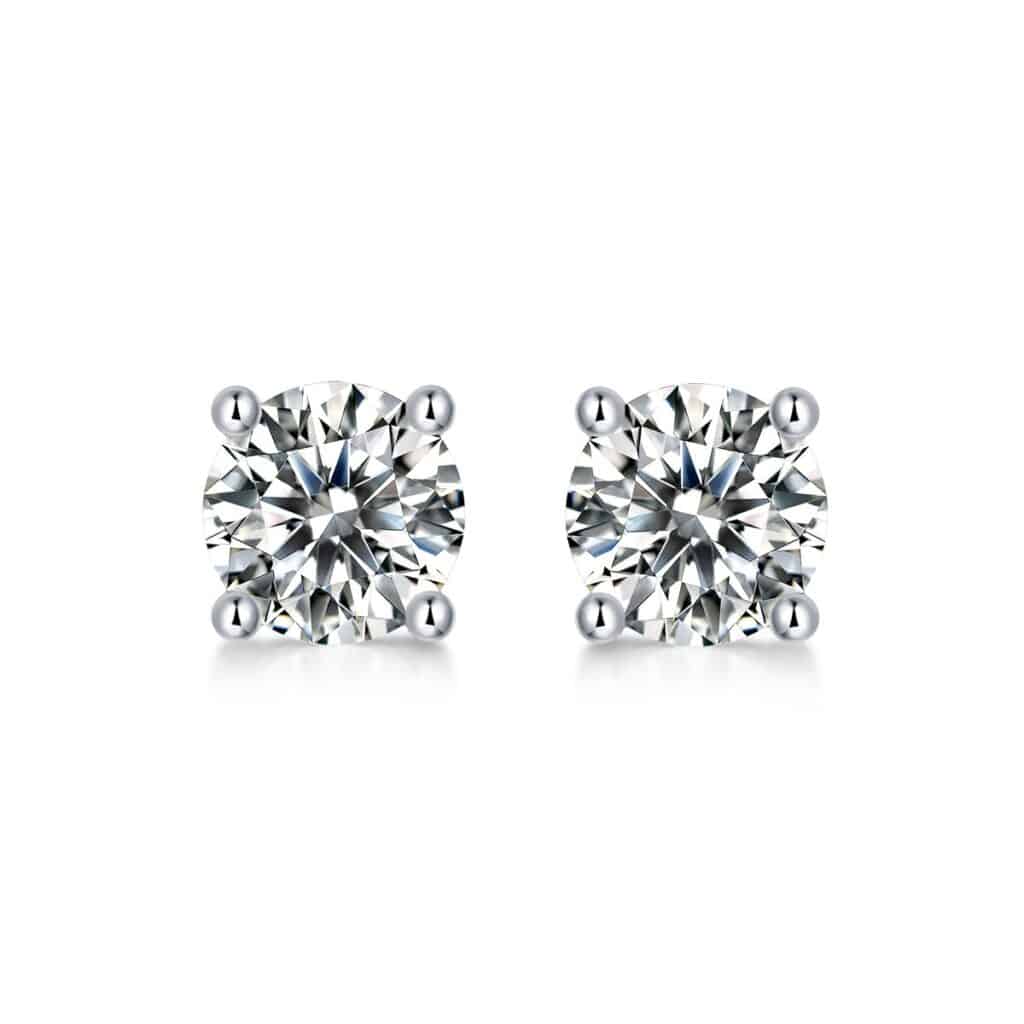
Sweat is the accelerant in all four cases, which is why the B-stock instinct fails here: in a polybag the flaw looks stationary; on a wrist it is a reaction in progress. Before accepting any lot, wear-test a sample of each defect class for a day and re-inspect under magnification. If the flaw grew, that class is not seconds stock — it is scrap with a discount attached. Plating thickness is also a fair question to ask: defined minimums are what make plating claims checkable at all, which is why our own vermeil specification publishes 18K at 2.5 µm or more over recycled 925 silver. Start your suspicion with prong-set designs: claw tips and gallery edges carry the thinnest plating and the highest flex, and four-prong settings like the studs below are where to look first.
Check 2 — is the 925 hallmark and every engraving intact?
The 925 stamp is not decoration; it is the piece’s statement of composition. If the hallmark is missing, worn away, double-struck or positioned over a repair, the piece can no longer support a sterling-silver claim at resale — and alloy claims are legal statements, not marketing flavor: consumer rules on both sides of the Atlantic treat a mis-stamped or mislabeled alloy as a compliance failure, not a discount opportunity. A missing hallmark also dissolves buyer trust in a glance, because the stamp is the one thing a retail customer checks without being taught.
Engraving matters twice over on moissanite pieces. Graded moissanite carries a laser-inscribed girdle — the program our own stones use is verifiable under any 10x loupe — and that inscription is what ties a loose stone to its certificate. If a second has been re-set or its stones swapped, the stone-to-certificate chain breaks, and the certificate you hand the end customer describes a stone you cannot prove is in the setting. Check each stone’s girdle against its paperwork. Treat personalization defects — misspelled names, wrong dates — as unsellable rather than discounted: nobody buys a mis-engraved gift at any price.
Check 3 — has the piece left its original compliance test batch?
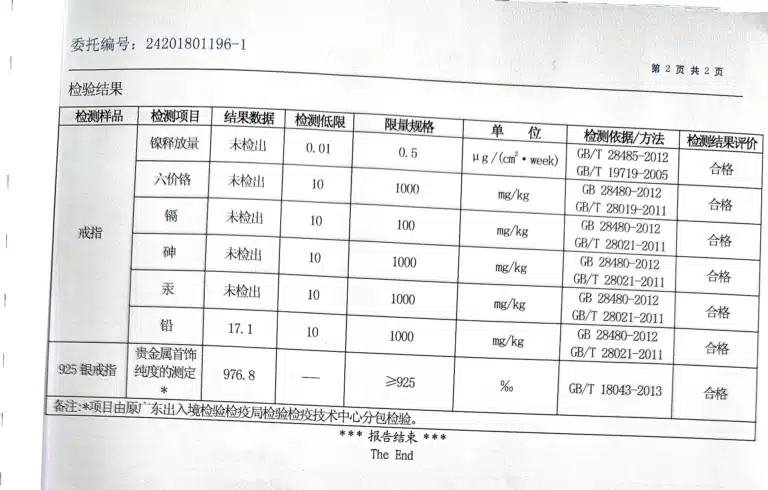
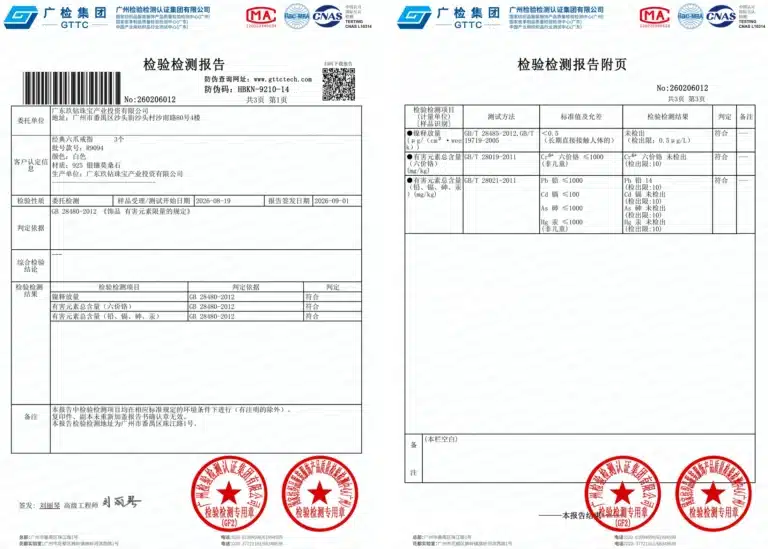
This is the check even careful importers miss. Suppose the factory’s A-grade line ships with third-party assay and nickel-release results — the pattern on our certifications and test-report page, where the reference report assays the silver at 976.8 per mille, finds nickel release not detected against the REACH entry 27 limits, and lead at 17.1 mg/kg against a 1,000 mg/kg ceiling, tested to the EN 1811 method. That report is evidence about one surface state: the alloy, coating and joints exactly as they existed when the sample was drawn.
A second that has been re-polished or re-plated no longer shares that surface state. Re-polishing removes metal and can thin or expose plating; re-plating runs the piece through a bath — possibly a different bath, with a different strike layer and thickness — and nickel-release compliance depends on precisely those variables. The restriction this is measured against, REACH Annex XVII entry 27, caps nickel release at 0.5 µg/cm² per week for articles in prolonged skin contact and 0.2 for post assemblies, and allows non-nickel coatings only where they hold the limit for at least two years of normal use (the full entry text is published here). A re-plated piece has, by definition, a new coating and a new surface — so the honest answer to “is it still compliant?” is “untested.” The same logic covers lead and cadmium: an assay speaks for the material tested, and if solder was redone or components replaced, the composition claim needs fresh verification, not inheritance.
So ask the factory one question before money moves: were these seconds reworked, and if so, what exactly was done? Acceptable answers come with paperwork — a new EN 1811 result and assay for the reworked lot, or written confirmation that pieces are sold as-is for markets where you will run the testing yourself. Acceptable answers never include “same batch as the A-goods, just polished again.”
It is also worth knowing what rework physically looks like. The video below shows ordinary bench work on moissanite pieces where setting, plating and QC share one floor: a setter adjusting a tennis bracelet, links closed with pliers, a chain inspected under task light, and silver re-polished on a buffing wheel.
The buffing-wheel sequence is the one to remember when someone offers you re-polished seconds: that wheel is precisely where thin plating, surface metal and shallow edge engravings disappear — and where a tested surface state ends.
What Should a Pre-Acceptance Checklist for a B-Grade Offer Contain?
- Get the defect schedule in writing — per piece and per defect class, with reference photos, so “cosmetic seconds” means a defined list instead of a mood.
- Sort every defect class into static or progressive using the four disqualifiers above and strike progressive classes from the deal.
- Verify hallmarks and inscriptions on a sample from every lot — stamp legibility, correct 925, no stamps over repairs, girdle inscriptions matching certificates.
- Document all rework, and require fresh EN 1811 plus lead and cadmium results for reworked lots — or exclude reworked pieces entirely.
- Wear-test and magnify a sample of every defect class before acceptance, not after.
- Fix the warranty in writing. Our A-grade goods carry a 12-month anti-tarnish and stone-loss warranty; for seconds, decide explicitly whether any warranty applies and put it on the invoice — silence means the risk is yours.
- Protect the payment. Request a video of the actual seconds lot before the balance payment — the same habit described in our guide to the batch video we send before balance payment.
When Should You Walk Away from Factory Seconds Entirely?
Walk away when the factory cannot tell you why each piece failed — a grading without defect classes is an inventory dump, not a seconds program. Walk away when reworked pieces carry no new test results, when hallmarks are missing on more than a stray piece, and when the price looks like scrap pricing. A discount that arrives without traceability is not a budget line; it is someone else’s quality problem wearing your brand.
FAQ: Buying B-Grade S925 and Moissanite Stock
Is jewelry “B-grade” the same as B-stock in electronics?
Only in the discount. Electronics B-stock grades static cosmetic flaws on inert materials; jewelry seconds can carry progressive faults that spread with sweat and wear. Grade the defect classes, not the price.
Does re-plating make a second as good as new?
No. A new coating is a new surface: nickel-release compliance under EN 1811 and REACH entry 27 — including the two-year coating guarantee — applies to the new surface, so re-plated pieces need fresh testing before resale as compliant.
Can I legally resell factory seconds?
Generally yes, provided you disclose second quality honestly and the pieces still meet the product-safety rules of your market: alloy claims, nickel-release limits and heavy-metal restrictions apply to discounted goods exactly as to full-price ones.
Should the factory’s 12-month warranty cover seconds?
Negotiate it explicitly. Our A-grade goods carry a 12-month anti-tarnish and stone-loss warranty; for seconds a factory will often offer none, and silence on the invoice means the risk transfers to you — so price it into the discount or decline the lot.