








Прямой ответ: Упаковка 3 000 колец из стерлингового серебра в морской контейнер — задача сухой упаковки, а не тары. Количество сорбента считают по объёму свободного воздуха в запаянном блоке, влаге, которую заносят гигроскопичные упаковочные материалы, паропроницаемости барьерной плёнки и полной длительности «от двери до двери» — никогда по числу изделий. Контейнерный дождь — второй и отдельный риск: воздух, запаянный на горячем влажном отправлении, конденсируется на крышке контейнера, когда коробка остывает, и капли падают на верхние коробки. Требуйте термоупаечный барьер с указанием WVTR в граммах на квадратный метр в сутки, не пускайте в упаковку серосодержащие материалы и принимайте отгрузку, только когда индикатор влажности внутри запаянного блока при прибытии показывает диапазон 30–40% RH.
Почему число колец — неверная единица для сорбента?
What does a desiccant have to remove?
Three things. The water vapour dissolved in the air trapped inside the sealed unit when you close it — a carton stuffed on a summer packing floor at 80% RH carries far more of it than one packed in a conditioned room. The vapour bound into hygroscopic materials: dividers, paper inserts, tissue, foam, the pallet underneath. And the vapour that migrates inward through the barrier film itself, every day of the voyage and every day the goods then sit in your warehouse.
That structure is not folklore. DIN 55474, Auxiliary means of packaging – Desiccants in bag – Application, calculation of the required number of desiccant units, covers desiccant bags used inside low-permeability packaging and exists to standardise exactly this calculation.
So what are the real inputs?
| Условие | What you measure or obtain |
|---|---|
| Free air volume per sealed unit | Carton internal volume minus pouches, foam and inserts |
| Moisture in the air at sealing | Logged temperature and RH on the packing floor |
| Hygroscopic load | Mass of paper, card, wood and foam inside, and whether pre-dried |
| Barrier permeability | The film’s WVTR in g/m²/day, from the converter’s data sheet |
| Barrier surface area | Total bag area the vapour crosses |
| Duration | Packing date to opening at destination, including port dwell and customs |
| Desiccant capacity | Grams of water one unit holds at your final target RH |
Divide the total water load by the capacity of one unit and round up. Ring count appears nowhere in that table; it enters only indirectly, because more rings need more pouches, which changes the free air volume and the hygroscopic load.
What does an order of magnitude look like?
The terms scale differently, so do not copy a count from another buyer’s spec sheet. Trapped air scales with the humidity on your packing floor, which you control. The dunnage term scales with the paper and board you include. The permeation term scales linearly with days and with the film’s WVTR: ten times the permeability needs ten times the desiccant for that term, and a 60-day window needs twice that of a 30-day window. On long sea lanes permeation dominates, so the cheapest place to cut desiccant is not the desiccant — it is the film. Have your supplier run the calculation from your inputs and attach it to the packing spec.
Container Rain: What Your Desiccant Cannot Fix Alone
How does it rain inside a closed steel box?
The mechanism is temperature, not weather. Cargo is stuffed at a hot, humid origin, so the box is sealed with warm, moisture-laden air. As the vessel moves into cooler latitudes the steel roof cools first and fastest; the air touching it drops below its dew point, and water collects on the underside of the ceiling, grows into droplets and falls onto the cargo. The CTU Code — the IMO/ILO/UNECE Code of Practice for Packing of Cargo Transport Units — describes this container sweat directly: daytime warming draws vapour out of the cargo and packing into the upper air, then falling afternoon temperatures take the air near the roof to dew point and form hanging drops. That is why the top cartons take the damage and the complaint looks random from the retail end.
Where does that water come from?
Three sources, all packaging-derived. The container floor and pallets are hygroscopic wood. Cartons and paper dunnage hold several percent moisture by weight and release it as the box warms and cools. The air sealed in at stuffing carries its own load. Silver itself is not hygroscopic, which makes this a packaging problem rather than a cargo problem.
Why is silver at risk even when nothing drips?
Tarnish is a surface reaction between silver and sulfur-bearing gases, and its rate climbs steeply with relative humidity. The same CTU Code text states the thresholds plainly: below 100% RH prevents condensation, below 75% limits mould growth, and below 40% is what prevents corrosion; its guidance for ferrous cargo is a protective coating or measures that hold RH reliably under that threshold. A sealed container is not stable, though: a reading that looks safe at loading drifts as the box breathes through temperature swings, which is why the number must be held by a barrier and a desiccant together.
What are the container-level countermeasures?
- Container desiccants hung from the lashing rings, spaced along the length, not bunched at the doors.
- A barrier liner, so condensation forms on the liner and runs to the floor channel instead of onto your cartons.
- Dry dunnage and dry pallets, and no stuffing after rain.
- Stowage position: keep high-value cartons off the top layer, where roof drips land.
- A per-route ventilation decision. Vents remove vapour only while outside air is drier than the air inside; on a hot-to-cold lane they can add moisture. Confirm the setting with your forwarder rather than defaulting.
Барьер и сорбент: какие спецификации в заказ-наряде?
How should the barrier be written?
Write four things and refuse substitutions without written notice: a water-vapour transmission rate in g/m²/day at a stated test condition, from the converter’s data sheet and not a brochure adjective; the barrier class, since foil laminate, metallized laminate, polyethylene and OPP are not interchangeable; heat-sealability with named seal parameters, because a folded and taped closure is not a seal; and a puncture resistance that suits a bag stacked under cartons for a month. A film without a WVTR value leaves the permeation term of the calculation undefined. Then verify before the doors close: keep the dry-package spec on the work order, pull a sample seal, and record seal temperature and dwell.
How do you choose the sealed unit size?
Match it to the shipping carton, not the pallet and not the individual ring. A per-ring pouch is a retail decision with almost no desiccant benefit, because the volume you protect barely changes. A per-carton sealed barrier bag is the practical middle: a countable quantity, its own humidity indicator, and a failure that costs one carton. For 3,000 rings across inner boxes, your desiccant supplier needs one figure — the free air volume of one sealed unit, multiplied by the number of units. Sealing per carton also caps the damage: one barrier bag across a pallet means a single puncture costs the consignment.
What must be kept out of the pack?
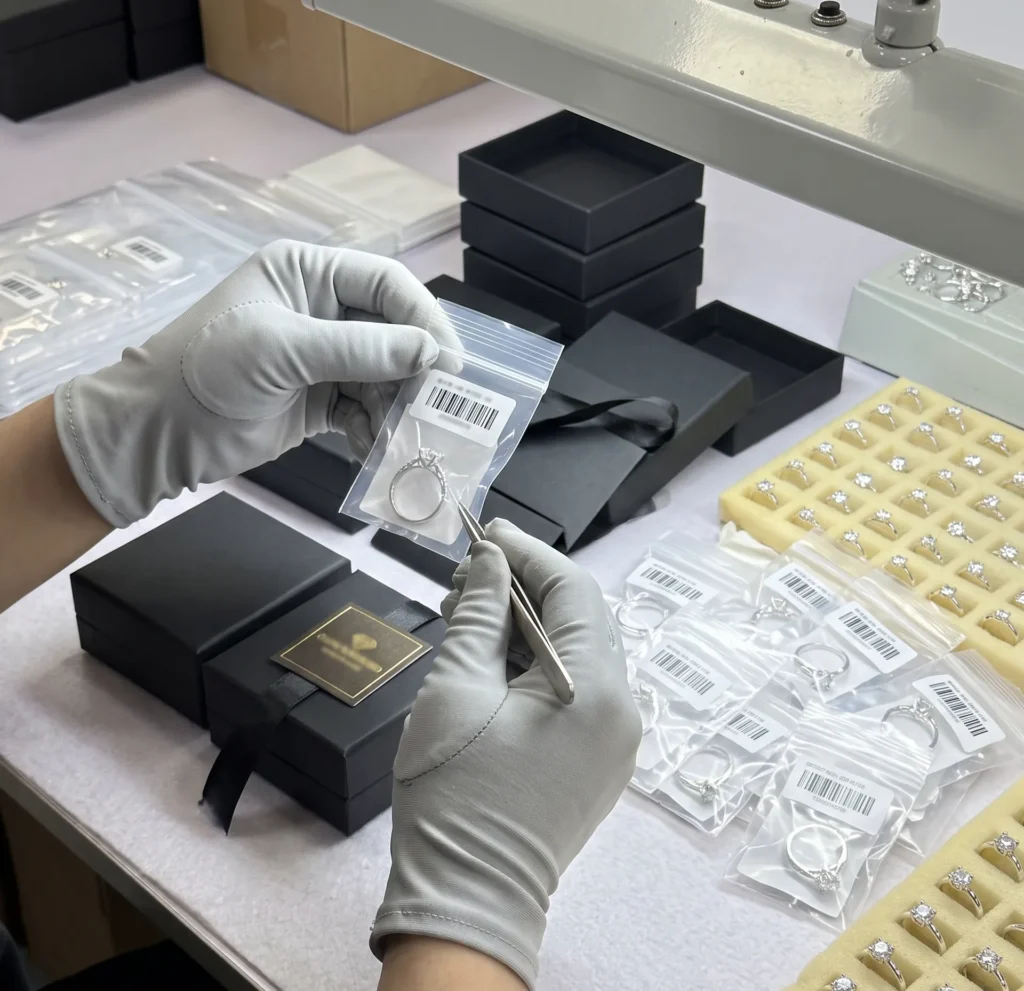
Sulfur, in any form that can off-gas: rubber bands, some adhesives and foams, and certain papers carry compounds that attack silver from inside a perfectly good barrier bag. Conservation practice is acid-free, sulfur-free tissue around each piece, then a sealed polyethylene bag with desiccated silica gel in the same enclosure — recommended by the Canadian Conservation Institute’s guidance on the care of silver. Retail packing does a different job: an individually packed, barcode-labelled OPP bag keeps the SKU identifiable and lets the factory photograph the piece before the carton closes, but an unsealed bag is not a barrier layer and must never be counted as one.
Приёмка по прибытии: что читаете, что бракуете?
Is 30–40% RH the right arrival band?
No standard publishes a silver-specific arrival figure, so 30–40% RH is the working band you write into the PO: below the 40% corrosion threshold, with margin for indicator-card error, and clear of over-drying. A sealed unit in that band proves the barrier held and the desiccant had capacity left; a unit reading near 20% means you over-specified desiccant and are paying for it on every shipment.
Where and when do you read it?
Inside the sealed unit, before it is opened, on an indicator card visible through a window patch or pressed against the film, read against its colour chart at dock temperature. Log it per carton against carton ID and lot number. Sample across the stack, not the first carton you reach: the top layer is where container rain lands.
What if the indicator is above the band?
Treat the reading as a gate with three outcomes. At 40–50% RH the barrier held but the desiccant is spent: accept after visual inspection, then raise the desiccant or cut the WVTR on the next PO. Above 50%, or on any sign of water contact, quarantine and inspect every affected carton, then raise it inside the claim window. A missing card is a process non-conformance even when the jewelry looks perfect.
Why not open a cold container in a warm warehouse?
Because you can manufacture the damage you are testing for. A cold container is full of cold air; opening it in a warm, humid warehouse lets outside moisture condense onto the goods instantly, and silver surfaces offer plenty of nucleation sites. Let the container, or at least the sampled cartons, equilibrate before you open sealed units.
FAQ: Sterling Silver Rings in a Humid Sea Container
How many desiccant units for 3,000 rings?
Nothing that follows from 3,000 on its own. The count comes from the free air volume inside each sealed unit, the moisture in the air and dunnage at sealing, and the barrier’s WVTR multiplied by surface area and days — divided by the capacity of one desiccant unit at your target RH. A figure copied from another buyer’s shipment is a guess wearing a number.
Can I skip the barrier bags and use only container desiccants?
Not on a long lane. Container desiccants work on the air in the box, a large and constantly changing volume, and compete with moisture released by pallets and cartons. Sealing first shrinks the problem. Use both.
Will an anti-tarnish coating survive the crossing?
A coating reduces the reaction rate; it does not replace humidity control, because tarnish also attacks through pores, coverage gaps and unreached recesses such as the space under a pavé setting. Treat anti-tarnish treatment as the last line of defence and the dry package as the first, and match batch QC records against your arrival readings.
What should the packing clause in the PO say?
Name the film class and its WVTR, the closure method, the desiccant unit and count per sealed unit, the humidity indicator, the sulfur-free tissue requirement, and the arrival band with its sampling rule — then attach the calculation sheet. A clause that says desiccant included is not a specification; it is a promise with no number attached.
Amara Jeweiry packs and inspects at the source in Shenzhen, in the Shuibei silver jewelry hub — which is where the numbers above have to be produced. The оптовая программа sets out the OPP bag, barcode label, AQL 2.5 final inspection and carton-level QC reporting that a dry-package specification sits on top of; the FAQ covers the packing and shipping terms, the 12-month anti-tarnish and stone-loss warranty, and the third-party tested 976.8‰ silver purity behind the alloy. For what happens when humidity wins, the silver cleaning and tarnish guide covers a ring that has already discoloured, the receiving-test walkthrough shows how to document a finding on arrival, and Уход за вермейлом и серебром collects the rest of the storage material for buyers drafting a packing clause.