






Short answer: purity marking for jewelry sold in the United States is governed federally, and a missing extra “state hallmark” is not, by itself, a recognized ground for a refund. The federal framework — the FTC’s Guides for the Jewelry, Precious Metals, and Pewter Industries (16 CFR Part 23) and the National Stamping Act — defines what may be stamped, what counts as misrepresentation, and who is liable. State statutes echo those prohibitions; echoing is not inventing, so a mirror statute creates no new mark to stamp and no automatic refund right. When a buyer writes “my state requires a hallmark your S925 line doesn’t carry,” verify the citation before touching the refund. Below: a five-step verification path — statute, attorney-general cross-check, federal comparison — and a refund-demand checklist.
Is US purity marking federal law or state law?
Start from the federal layer, where the enforceable rules live. The FTC’s jewelry guides are codified at 16 CFR Part 23, and the section that matters to any S925 discussion is 16 CFR 23.5. It states that “it is unfair or deceptive to misrepresent that an industry product contains silver,” and sets the thresholds: “Sterling Silver” or the abbreviation “Ster.” may not be used on a product “unless it is at least 925/1,000ths pure silver,” and the unqualified word “silver” may only appear next to “an equally conspicuous, accurate quality fineness designation indicating the pure silver content.”
Layered under the guides is the National Stamping Act, the 1906 statute codified at 15 U.S.C. 294–300. It requires whoever applies a quality mark to also apply their own trademark or name, and the notes to 16 CFR 23.5 carry its tolerances — four parts per thousand for sterling without solder, ten parts per thousand where solder is present. See our piece on the 91.8% silver assay and the 4/1000 rule for how that tolerance plays out in a real dispute. Violations are a misdemeanor punishable by “a fine of not more than $500 or imprisonment for not more than three months, or both,” and — this matters for the refund question — 15 U.S.C. 298 lets competitors, customers, and subsequent purchasers seek injunctive relief, damages, and attorney’s fees when an article is stamped in violation of the act.
Note what that remedy list is attached to: misstamping. Federal law penalizes false claims about what the metal is — not the absence of some additional stamp — and contains no refund mechanism.
Why can’t a state require a hallmark the way the UK does?
Buyers making this claim usually import a mental model from London or Milan, where the UK’s Hallmarking Act 1973 runs a national assay-office system that physically marks articles and makes certain marks a precondition for describing them as silver — a system we walk through in our guide to UK and EU hallmarking for S925 silver. The United States has no equivalent: no state assay office, no statutory sponsor’s mark, and no state that requires a punch mark before an S925 ring can lawfully be sold as S925.
What US law requires is truth in labeling. The National Stamping Act’s state-law clause, 15 U.S.C. 300, says covered articles shipped into a state and remaining there “for use, sale, or storage” become subject to that state’s laws “to the same extent and in the same manner as though such articles of merchandise had been produced” there, and are “not exempt therefrom by reason of being introduced therein in original packages or otherwise.” Read carefully: the clause keeps state law applicable to interstate jewelry shipments. It does not let states invent new mandatory marks — it says your goods do not escape state law by crossing a state line.
Which state laws on jewelry marking actually exist?
States do legislate here, but thinly and in mostly mirror language: prohibitions on stamping silver with quality marks the metal does not merit, tracking the federal text. Secondary legal summaries commonly cite N.C. Gen. Stat. § 66-406 as a state marking statute alongside the federal scheme.
When we attempted to open the official text of that section on the state legislature’s site, ncleg.gov returned HTTP 403 to both the PDF and the HTML versions on 27 October 2026 — the same failure the article our buyer quoted apparently hit. We did not quietly substitute a summary we could not confirm. Until the official text opens, that citation is unverified, not proof that North Carolina mandates any particular stamp. That distinction — unverifiable versus false versus true — is the discipline this checklist operationalizes.

How do you verify a “my state requires a hallmark” claim in five steps?
Step 1: Make the buyer pin the citation
Reply in writing and ask for three things: the statute’s citation (state, chapter, section number), the sentence the buyer believes applies, and how they found it. State a window — five to seven business days — so the request reads as process, not stalling. A buyer with a real statute sends a section number within a day. A buyer working from an AI chatbot’s summary, or from a blog post whose own citation link is dead, usually cannot. Do not skip this even when the tone is heated: the file protects you if the claim escalates to a chargeback or attorney letter.
Step 2: Search the state legislature’s official site
Go to the state’s official legislative website and search the chapter and section directly. Two warnings from our own attempt: some state sites bot-block automated fetches (ncleg.gov’s 403s above), and a failed load is not evidence about the statute’s content — only about the website. If blocked, note the date and error, try a commercial statute mirror, and label it secondary in your notes.
Step 3: Cross-check the state attorney general’s consumer pages
If the statutory language is ambiguous, check how the state’s top legal officer explains jewelry marking to consumers. The federal USA.gov directory of state attorneys general links every state’s official AG site in one place. An AG consumer page that discusses jewelry marking at all will describe deception-based enforcement — false “sterling” claims, misrepresenting silver content — not mandatory additional stamps. The absence of any AG guidance about a required state hallmark is meaningful negative evidence.
Step 4: Compare the claim against the federal text
Put the buyer’s quoted sentence next to the federal baseline. If the state language they found merely prohibits misrepresenting silver content or stamping “sterling” on under-fineness metal, it adds nothing to what 16 CFR 23.5 already requires of you — compliance is compliance, and the “missing hallmark” framing collapses. One retrieval tip: the eCFR’s HTML interface redirected us to a bot-unblock page, but the same current text of 16 CFR Part 23 is retrievable through the eCFR’s official renderer endpoint, which opened cleanly. When a government page wall-blocks you, there is often an official machine-readable route to the identical text.
Step 5: Write down the verdict and date it
End every verification with a dated one-paragraph memo in the order file: what was claimed, what you found, what you could not open, and your classification — verified mirror statute, verified new requirement, or unverifiable. It converts a he-said-she-said dispute into a documented process — the most persuasive artifact if a payment network later reviews the case.
What did we find when we ran this checklist on the North Carolina citation?
Running our own steps on the claim our buyer quoted: Step 1, the citation came from a secondary article, not their own research. Step 2, ncleg.gov 403’d both formats on 27 October 2026, so the official text could not be read. Step 3, we did not reach the North Carolina AG’s consumer pages in this session, so that cross-check remains open. Steps 4 and 5, the federal baseline was confirmed against Cornell’s mirror of 16 CFR 23.5 and 15 U.S.C. 298–300, and the verdict recorded is “unverified citation; no confirmed state-mandated mark.” We are publishing the incomplete result on purpose: honesty about gaps is what separates a verification process from the conclusion-only pages that left the buyer stuck.
Is a missing state hallmark a recognized ground for a refund?
Under the federal scheme, no. The remedies that exist attach to misstamping — false quality marks — not to the absence of a stamp nobody’s law requires. A buyer who received accurately stamped, genuinely 925 silver has not received misstamped goods, and no provision we could verify makes “my state wanted another mark” a statutory refund trigger. Two caveats keep this from being a blank check. First, if the buyer’s contract or purchase order specifies an additional mark, the contract governs — commercial-negotiation territory, not statute. Second, this space is noisy: our buyer arrived holding two AI-generated answers that directly contradicted each other — one saying their state “may force a refund,” the other saying a missing state mark is not a recognized refund basis. Both cannot be right, and neither is a citation. When a buyer cites an AI summary, that is your cue for Step 1 of the checklist, not for a refund.
How should you handle the refund demand? A working checklist
- Acknowledge without conceding. Thank the buyer, restate their claim in one sentence, and send the Step 1 citation request. Tone: cooperative, deadline-set, zero admission.
- Verify or log as unverifiable. Run the five steps. A dead official website is a logged obstacle, not a verdict.
- Classify the finding. (a) No statute named: US quality marking is governed by 16 CFR Part 23 and the National Stamping Act — attach your compliance documents. (b) Mirror statute found: show the same documents — the state law adds no new mark. (c) A genuine additional requirement found: quote the sentence, get counsel’s read, and decide between re-marking and a commercial remedy.
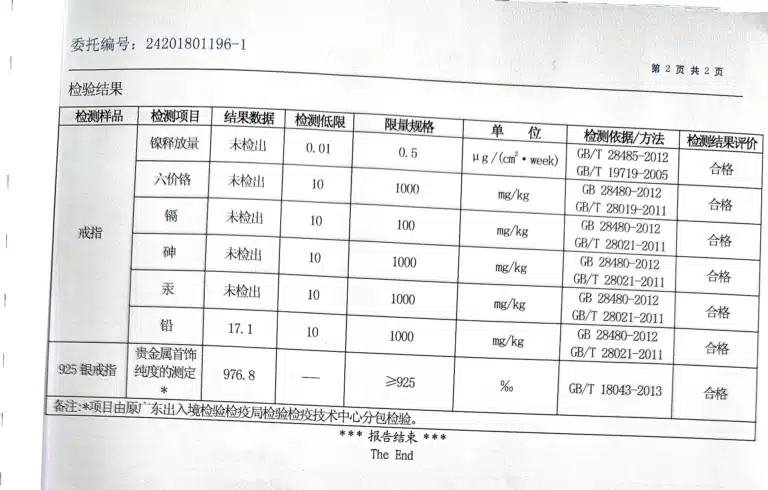
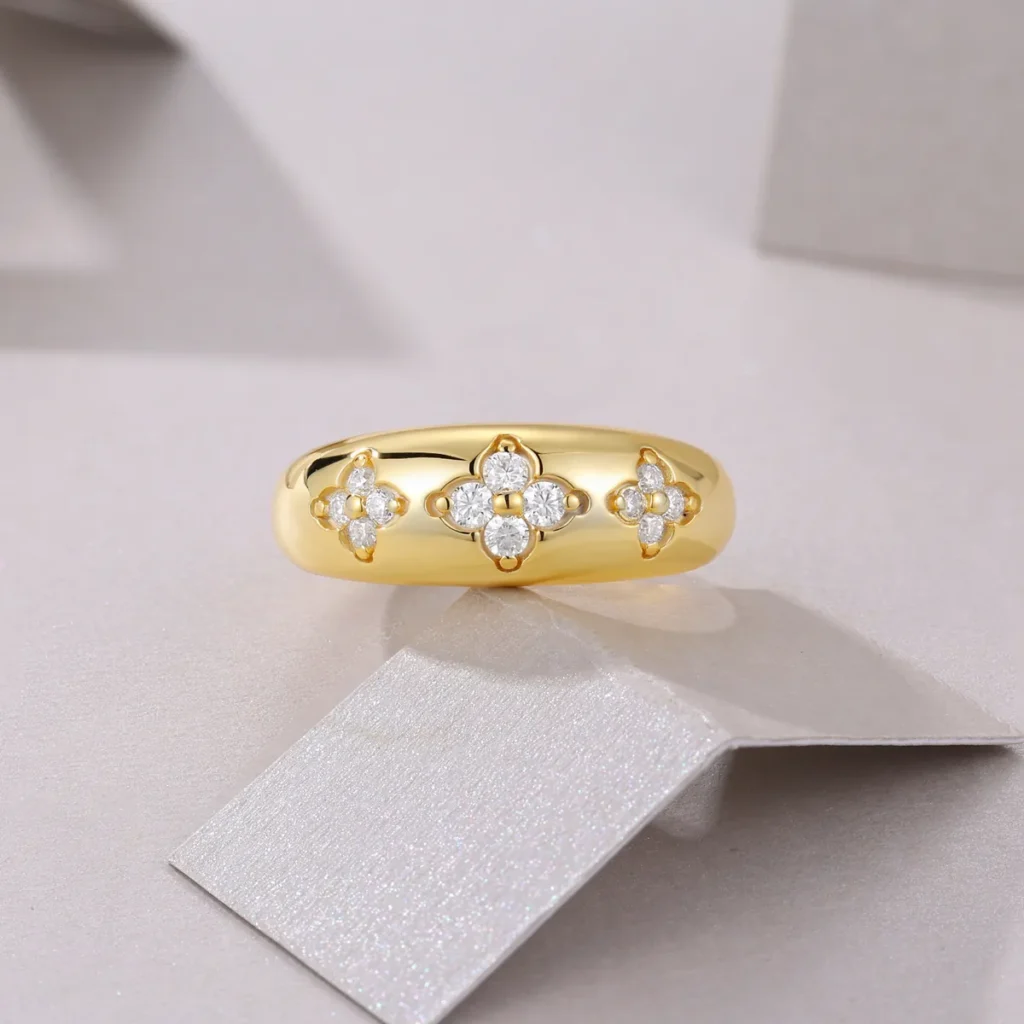
- Match evidence to the fineness claim. Our S925 line — moissanite tennis chains, rings, earrings, necklaces, and bracelets produced in Shenzhen since 2010 — carries the 925 fineness mark with the client’s brand laser-etched adjacent, a service we describe in our guide to laser-etching a brand mark next to the 925 stamp. Substantiate the metal with third-party assay reports and AQL 2.5 inspection records from the batch.
- Preserve the batch record. If the dispute can escalate, assemble the pre-shipment evidence: the batch video taken before the balance payment, assay paperwork, and your dated verification memo.
- Decide the commercial question separately from the legal one. Once the legal analysis says “no refund obligation,” you may still offer a goodwill remedy — a replacement on the next order, a discount on re-marked goods, or a refund on your own terms. Frame it in writing as goodwill: a refund framed as “we were wrong” invites the next claim; one framed as “here is what we can do commercially” closes it.
FAQ
Do any US states require a 925 stamp on silver jewelry?
No state system we could verify requires a stamp as a precondition for selling, in the manner of UK assay offices. Where verifiable, state statutes mirror the federal prohibitions on misrepresenting silver content. Run the five-step check on the specific state named — this guide’s conclusion is only as current as its verification date.
Is “925” the same thing as a hallmark?
Not in the British sense. In the US, “925” is a quality mark governed by federal truth-in-labeling rules: accurate within the National Stamping Act tolerances and accompanied by the stamper’s trademark or name. A UK/EU “hallmark” is an independent assay office’s certification mark, which no US state replicates.
Can a buyer force a chargeback over a missing state hallmark?
A buyer can attempt one — typically as “item not as described” — but the outcome turns on documentation, not the claim’s wording. A dated verification memo, accurate 925 stamps, and assay evidence are what a payment network weighs.
What if the state statute genuinely cannot be opened online?
Say exactly that, in writing, with dates and error codes. Then try the official API route (as we did with the eCFR), a statute mirror labeled as secondary, or the state AG’s consumer pages. If it still will not open, classify it as “unverified” and propose that the buyer’s counsel obtain the official text, rather than a refund or a refusal built on an unopened document.