







Réponse courte : donnez au fermoir son propre résultat de libération de nickel au niveau du composant. Un corps S925 et un fermoir à ressort en métal de base sont des matériaux différents, donc la pièce est un article hétérogène pour les besoins d’EN 1811. La réglementation fixe une seule limite de libération pour l’article, mais la préparation d’échantillons de la méthode découpe un article hétérogène en sous-parties homogènes, et chaque sous-partie en contact avec la peau doit respecter 0,5 µg/cm²/semaine. Un résultat sur la pièce entière ne peut tenir lieu pour le fermoir que lorsque le fermoir et le corps partagent le même alliage et la même finition, ou lorsque le fermoir a déjà un rapport valide du même lot et de la même finition et que l’essai sur la pièce entière couvre le corps. Sinon, démonter, découper ou masquer le fermoir et le tester séparément, après simulation d’usure EN 12472 s’il est plaqué.
EN 1811 teste-t-elle la pièce entière ou chaque matériau ?
EN 1811 is the reference method for entry 27 of Annex XVII to REACH, which lists necklaces, bracelets and chains among the articles in direct and prolonged contact with the skin and sets a nickel release limit of 0.5 µg/cm²/week. The European Commission’s C/2023/1604 communication lists EN 1811:2023 as the current standard for that entry. The method immerses a specimen in artificial sweat for one week, measures the nickel that migrates into the solution, and divides that mass by the exposed surface area. The output is a release rate, not a nickel content figure.
That detail decides the sampling question. A test result belongs to the specimen that was immersed. If the specimen is the whole necklace, the result describes the whole necklace; if it is the clasp alone, the result describes the clasp. EN 1811’s sample-preparation guidance treats an inhomogeneous article as a set of homogeneous sub-parts and expects each skin-contact sub-part to be represented. A silver chain and a plated base-metal spring clasp are not one material. They are at least two, plus the plating and possibly a separate spring steel inside the clasp.
The lab tests what the request tells it to test. The useful question is which specimen answers your buyer’s question.
Un fermoir à ressort en métal de base a-t-il besoin de son propre essai de libération de nickel ?
Yes, when the purpose is to show the clasp complies. The clasp is usually the highest-risk component on an S925 piece. It is a different alloy from the body, it is often plated, it has edges, holes and rubbing contact points where plating is thin, and it may come from a different supplier and lot than the chain. A whole-piece result cannot separate that risk from the silver.
There is a legal side and an analytical side. Legally, the restriction applies to the article placed on the market, and a whole-article test that includes the clasp can demonstrate that the article as tested meets the limit. Analytically, the same test is a poor instrument for the clasp, because the clasp is a small fraction of the wetted area. A pass does not tell you the clasp passed. It tells you the average passed. If the buyer asks for component data, or if the market’s enforcement practice asks for each sub-part, the whole-piece number will not answer the question.
A whole-piece test is reasonable in three situations: the clasp and body are the same alloy and finish; the clasp already has a valid component report for the same material, finish and lot, and the whole-piece test covers the body; or the test is an early screen and the buyer has agreed in writing to article-level data. On a base-metal clasp and S925 body, the first is false by definition, so the other two need documentation.
When Should the Clasp Be Removed, Cut or Masked?
Separate the clasp when any of these is true:
- the clasp alloy differs from the body alloy;
- the clasp is plated or coated, especially with a nickel underplate;
- the clasp has a spring, tongue or hinge that rubs and exposes substrate;
- the clasp comes from a new supplier, a new lot or a new plating line;
- the buyer’s specification asks for a component result;
- a previous whole-piece result sits at more than half the limit, so you need to know which part is driving it.
Disassembly is the first choice when the clasp is a separate finding attached with jump rings. Cutting is the fallback when it is crimped or sealed onto the chain. Masking is the tool when the clasp cannot be removed: the lab coats the body with wax or lacquer, leaves the clasp’s skin-contact surfaces exposed, and photographs the mask. Ask for before-and-after photos and the measured exposed area, not just a note that the clasp was isolated.
Comment un résultat sur la pièce entière peut-il noyer par moyenne un fermoir en échec ?
Nickel release is normalized by area. That is the point of the unit: it lets a lab compare a large chain with a small ring. It also means a small, high-release component can disappear inside a large, low-release body. The arithmetic is simple and worth doing before you accept a report.
| Surface | Exposed area | Hypothetical release | Nickel load per week |
|---|---|---|---|
| S925 body | 38 cm² | 0.05 µg/cm²/week | 1.9 µg |
| Spring clasp | 2 cm² | 2.00 µg/cm²/week | 4.0 µg |
| Whole piece | 40 cm² | 0.15 µg/cm²/week | 5.9 µg |
The clasp in this example is four times over the 0.5 limit on its own. The whole piece reads 0.15, comfortably under the limit. The numbers are hypothetical and only there to show the mechanism, but the mechanism is real: the larger the silver body, the more the clasp is diluted. A long tennis chain with a small clasp is an extreme case; it can make almost any clasp look acceptable.
This is why “we tested the whole piece and it passed” is not a clasp result. It is also why a report that masked the clasp out is a body report. In that case the clasp was not tested at all, and the report should say so.
What Must the Report Show?
Ask for these fields before you treat a report as clasp coverage:
- specimen description: clasp type, alloy, plating, finish and dimensions;
- the SKU or article family, and the lots the result covers;
- pre-treatment: EN 12472 wear and corrosion simulation, yes or no, and the cycle;
- masking: what was covered, with what, and photographs;
- exposed area in cm² and nickel mass in µg, plus the release in µg/cm²/week;
- the decision rule against 0.5 µg/cm²/week, including measurement uncertainty;
- the method and whether it sits inside the lab’s accreditation scope.
A report that lists “necklace, 1 pc” and one number is not necessarily wrong, but it is not a component report. If the clasp is named and the area is listed, you can defend it; if not, you cannot tell what was tested. Put the instruction in the test request itself: “test the clasp as a separate specimen; do not report a whole-piece average.”
Un fermoir représentatif peut-il couvrir tout un lot ?
Yes, as a documented sampling decision, not as a certificate for every clasp in the box. One clasp can represent a family when six things match: supplier, alloy grade, plating specification and thickness, surface finish, geometry, and production lot. Same batch, same material, same surface is the minimum; geometry and supplier are the two conditions buyers most often forget.
The report should name the family and the SKUs it covers. What breaks the family is any change to those six inputs: a new supplier, alloy, plating thickness, finish, spring source or lot. A new color is not automatically a new family if the plating chemistry and thickness are unchanged, but the finish is a variable and the lab should confirm it.
For high-risk accounts, test per lot or per supplier change. For a stable program, one representative test per material and finish family, repeated when a process changes, is defensible. Write the sampling plan down and make the report’s scope match it. A result from one lot does not certify a different lot.
Why XRF, Nickel-Free Plating and the Assay Report Are Not Enough
Three documents get mistaken for nickel release evidence. An XRF reading measures elemental content on the spot; it does not measure release into artificial sweat. It is useful for screening and useless as a pass or fail result for entry 27. A “nickel-free plating” statement describes the plating on the parts the plater ran; it does not describe a purchased clasp that may have its own plating. An assay report for silver purity is a different test, even when it covers every metal component. The assay rule that every metal part must be submitted is about fineness, not nickel release; our UK and EU hallmarking guide for S925 silver sets out that submission rule, while our article on S925 assay tolerance explains the 4/1000 rule and the solder allowance behind the result.
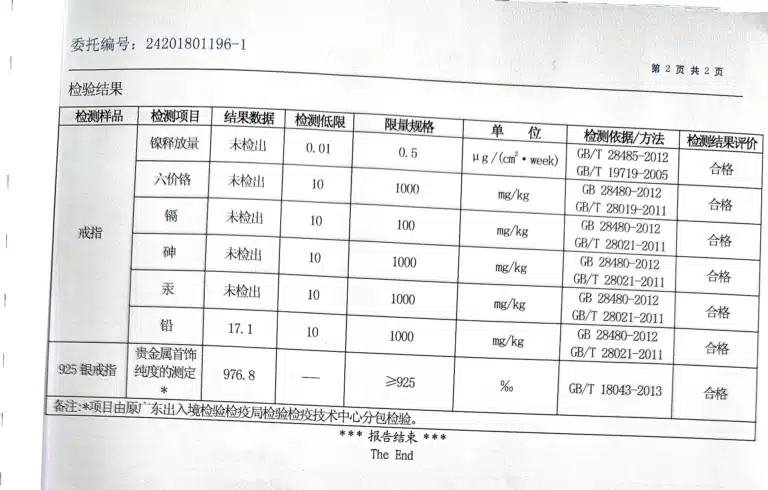
Our published compliance pack reports nickel “not detected” against the 0.5 µg/cm²/week limit, lead at 17.1 mg/kg against a 1,000 mg/kg limit, and cadmium, chromium VI, arsenic and mercury not detected; the page des certifications lists report No. 24201801196-1 and CMA No. Z212412928083. Read the scope of any report before treating it as clasp coverage. A nickel-free plating specification on the silver body does not answer what the clasp’s plating contains.
Keep the nickel release report, the assay report and the plating specification separate in the buyer’s compliance folder. Our article on UK and EU hallmarking for S925 silver explains how those documents sit alongside hallmarking evidence.
FAQ
Is a spring clasp a post assembly under REACH?
No. The 0.2 µg/cm²/week post limit applies to assemblies inserted into pierced ears or other pierced body parts. A spring clasp on a necklace or bracelet is a skin-contact component and is assessed against 0.5 µg/cm²/week. Earring posts on the same order are a different story; do not use a clasp report to cover them.
If the clasp is nickel-plated, does a thick plating remove the need to test?
No. Thickness helps, but plating is thinnest at edges, seams and spring contact points, and wear changes the surface. A coated article is tested after EN 12472 wear and corrosion simulation, and if there is uncertainty about nickel in the coating, the lab may need to run the test with and without that pre-treatment.
Can I use the whole-piece result if it passes?
You can use it for the article, but not as proof for the clasp. If the clasp was included and unmasked, the article as tested met the limit. That does not tell you the clasp’s own release rate, and it does not survive a request for component data. If the clasp was masked, the clasp was not tested.
What if the clasp is too small for a reliable area measurement?
Labs handle small specimens by testing several identical clasps together and dividing the nickel mass by the combined exposed area. Ask how the area was determined and whether the report includes the individual pieces. A very small clasp tested alone can fall below the method’s reliable area; combining identical clasps is better than a number with a wide uncertainty.
Que cela signifie-t-il pour votre prochaine commande S925 ?
The clasp is a small part with a large compliance footprint. On an S925 piece with a base-metal spring clasp, the defensible file contains a clasp-level EN 1811 result with the area, pre-treatment, masking photos and lot scope, plus the body result and the assay. Whole-piece testing still has a place as a screen and an article-level check, but it is not a substitute for the clasp result.
If your account needs a clasp-specific line item, ask for the clasp specification and report scope in writing before the PO. The same rule applies from the first sample of a custom S925 piece: decide the clasp material and finish before the test plan. If a plating defect appears after delivery, our article on who pays for a plating defect claim separates a worn coating from a misdescribed base metal and sets out the receiving test and PO clause that decide the claim. That is a coating and material-description question, not a nickel release result.