








Neither report governs by default. When one laboratory reports an S925 silver batch roughly 20 mg/kg over the REACH cadmium limit and a second laboratory reports the same batch as passing, the outcome is decided by the decision rule written into your quality agreement — and if you never wrote one, it is decided by the dispute protocol you set up now, not by whichever report arrived first. The workable sequence is: put the batch on hold, split the sealed retained sample under both parties’ seals, retest at an ISO/IEC 17025-accredited arbitration laboratory named in advance, measure total cadmium by acid digestion with ICP-MS, and apply a written pass/fail rule that accounts for measurement uncertainty against the legal limit of 0.01 percent by weight (100 mg/kg). Arbitration retests are standard commercial practice in jewelry quality control — but only for buyers who agreed to one before the dispute started.
Which Cadmium Report Governs When Two Labs Disagree?
The one your contract says governs. A lab report is evidence, not a verdict: it converts a measurement into a pass or a fail only through a decision rule — which limit applies, on what basis (total cadmium, mg/kg, per homogeneous material), and how measurement uncertainty is treated. If that rule lives in your purchase order or quality agreement, the answer to “which result governs” is mechanical: the arbitration laboratory’s result, produced by the agreed method and judged by the agreed rule, governs. Everything else is negotiation leverage dressed up as metrology.
Buyers are often surprised that the factory’s release report and the buyer’s incoming-inspection report can carry equal formal weight and opposite conclusions. Both can be honest. Both can be accredited. Neither has inherent authority over the other, because no jewelry standard assigns priority between them.
What Happens If Your Contract Is Silent?
Then nothing governs, practically speaking. The batch sits in customs or in a bonded warehouse while both parties argue about whose lab is more credible, and the eventual settlement reflects commercial leverage rather than the true cadmium content of the metal. This is the gap this article exists to close: the industry publishes limits and methods, but not the adjudication procedure, so the procedure has to be created contractually — before the PO is confirmed, not after the claim.
Check the Number First: the Legal Limit Is 0.01% (100 mg/kg), Not 20 ppm
Under REACH Annex XVII, entry 23, metal parts of jewelry articles must contain cadmium at less than 0.01 percent by weight — that is 100 mg/kg, and since 1 mg/kg equals 1 ppm, it is 100 ppm. So “one lab failed the batch by 20 ppm” means that laboratory reported something near 120 mg/kg against a 100 mg/kg line, with the second lab presumably reporting below 100 mg/kg. Keep the units and the basis explicit on your spec sheet: total cadmium, milligrams per kilogram, per homogeneous material.
If your own specification instead says 20 ppm, understand what that number is: a private tolerance. Some brands adopt internal limits stricter than REACH — for children’s lines, brand positioning, or margin against future regulatory tightening — and that is a legitimate commercial choice. But it is not the legal limit, and confusing the two produces fake disputes: a batch at 85 mg/kg has passed EU law even if it fails a 20 ppm private spec. Decide which number runs the PO, and put it in the same clause as the arbitration rule.
Where a “20 ppm” Figure Usually Comes From
In practice, stricter-than-REACH numbers trace back to corporate social-compliance manuals, limits written for a different substance (lead rather than cadmium), or testing frameworks that use migration limits rather than total content, as toy standards do. None of these transfer automatically to adult S925 jewelry. The fix is boring but effective: quote the limit, its legal source, and its basis on one line of the spec sheet, so both labs are aiming at the same target.
Why Two Accredited Labs Can Disagree by 20 mg/kg on the Same Batch
Accreditation does not make two numbers identical. When the same S925 batch reads 95 mg/kg at one laboratory and 120 mg/kg at another, the spread usually comes from three sources — and knowing them tells you which results deserve weight in a dispute.
XRF Screening vs ICP-MS Digestion
A handheld XRF analyzer reads a small surface area to a fraction of a millimeter in depth. On a plated piece it is largely reading the plating layer, its response shifts with part geometry, edge effects and surface finish, and it reports against an internal calibration. That makes XRF a screening method: excellent for sorting a batch quickly, not a total-content measurement. ICP-MS after acid digestion dissolves the sampled metal and measures the total cadmium in solution with a documented detection limit — this is the quantitative method behind REACH-grade data. If one side screened with XRF and the other digested for ICP-MS, a 20 mg/kg disagreement is unremarkable. It is also why an arbitration clause must name the method, not just the lab.
Cadmium Does Not Sit Evenly Through an S925 Batch
Cadmium follows inputs: plating baths, solders, some recycled silver feedstock. One component of a piece can read high while the rest is clean, so a two-piece sample can swing tens of mg/kg depending on which pieces land in the digestion beaker. This is the same sampling logic behind our piece-by-piece test-scope article on a base-metal clasp on an S925 body, and it is why a serious protocol fixes the sampling plan in advance: how many pieces, from which cartons, and which homogeneous materials get tested separately rather than bulked together — the same two-gate thinking behind our pre-plating and post-plating inspection plan.
Uncertainty Budgets and Decision Rules
ISO/IEC 17025:2017 requires a laboratory to document its decision rule — how it turns a result plus uncertainty into a pass or fail — and to agree that rule with the customer before issuing a statement of conformity (clause 7.8.6). ILAC G8:09/2019, the guidance document laboratories use for exactly this, sets out the options from simple acceptance to guard-banded decisions where the uncertainty must clear the limit with margin. Two labs can honestly report 95 mg/kg and 105 mg/kg, each with an expanded uncertainty around ±15 mg/kg, and both results describe one and the same batch. This is why the arbitration protocol compares results through a written rule rather than by eyeballing two single numbers against a limit.
The Arbitration Retest Protocol, Step by Step
Here is the operational sequence to write into your QA agreement. It takes one page and it only works if it exists before the dispute.
Step 1: Hold the Batch and Preserve the Evidence
When a failing report arrives, the buyer notifies the factory in writing within an agreed window, and both sides freeze the batch: no shipment, no rework, no re-plating, no scrapping. Reworking a disputed batch destroys the evidence. Factories that already film batch documentation before the balance payment — as we recommend for every S925 order — have an easy extension here: seal the QC evidence along with the cartons.
Step 2: Split the Sealed Retained Sample
The retained sample is the piece of this whole mechanism, and it must exist before any dispute. Drawn at production acceptance from the same production run, sealed in tamper-evident bags, logged against the batch number. On a dispute, the sealed samples are split: one portion to the buyer’s laboratory, one to the factory’s laboratory, and one that stays sealed for the arbitration laboratory. A chain-of-custody sheet is signed at every handoff and the courier is agreed in advance. If no retained sample was kept, both parties test randomly drawn pieces from the held batch and accept that sampling variance widens the uncertainty — a weaker but workable fallback.
Step 3: Name the Arbitration Lab in Advance
The clause should name — or set out how both parties will select — a third laboratory, independent of both sides, accredited to ISO/IEC 17025, whose scope of accreditation explicitly covers cadmium in jewelry metals by digestion and ICP-MS. Check the scope annex on the lab’s certificate, not just the logo: accreditation is granted per method and matrix, and “ISO/IEC 17025 certified” on a website does not prove cadmium-in-silver is inside the scope. Cost allocation is commonly loser-pays; whatever you choose, write it down.
Step 4: Fix the Method and the Decision Rule in Writing
The arbitration method: total cadmium by acid digestion, quantified by ICP-MS, reported in mg/kg together with the expanded uncertainty and the decision rule used. Then the rule itself. A guard-banded example: “The batch conforms if the arbitration result plus the laboratory’s stated expanded uncertainty does not exceed 100 mg/kg.” A simple-acceptance example: “The batch conforms if the arbitration result does not exceed 100 mg/kg.” Either is defensible; the fatal choice is leaving it undecided, because then each side interprets the same number differently. The clause ends with the sentence that gives the whole exercise force: the arbitration result is final and binding on both parties.
Step 5: Pre-Agree the Consequences
If the arbitration result passes, the batch releases and ships and the buyer’s claim closes. If it fails, the pre-agreed menu applies — re-plating and retesting, rework, scrap, credit note, or replacement — with deadlines. Where a batch fails a restriction, the rework-versus-scrap decision has its own logic, which we cover separately for nickel-release failures; the same framework transfers to cadmium. Without a menu, even a clean retest can dissolve into a fight over remedies.
Is an Arbitration Retest Actually Standard Practice?
In commercial practice, yes: pre-agreed third-party “umpire” testing is how international commodity and manufacturing trade has resolved conflicting lab results for decades, and the ISO/IEC 17025 plus ILAC G8 framework exists precisely to make conformity statements comparable between laboratories. But be precise about what no standard says: there is no published jewelry standard titled “S925 cadmium arbitration” — no ISO or ASTM clause designates an arbitration laboratory for cadmium disputes in silver jewelry. The mechanism is standard practice because contracts create it, not because a standard mandates it. If you have searched for an official arbitration procedure and found none, that is the correct search result. The five steps above belong in your contract text, not in your inbox after a claim.
FAQ
Which report governs while the retest is pending?
Neither. The batch stays on hold. The factory’s release report remains the production acceptance record and the buyer’s report remains the trigger for the protocol, but neither decides the batch — only the arbitration result does.
Is a small gap between two results meaningful?
Not on its own. Ask both laboratories for their reported expanded uncertainty and the decision rule they applied. Two results that differ by less than the combined uncertainty describe one and the same batch, and neither is “the true value”.
Can I rely on my own XRF screening gun?
For incoming screening and sorting, yes. As the deciding document, no: geometry, plating and surface effects make XRF a screening method. Use it to decide whether to trigger the protocol, not to close the claim.
We already mixed the batch into our inventory. Now what?
Batch identity is broken, and the sealed retained samples from production acceptance are the only batch-true evidence left. That is the strongest argument for making retained-sample sealing a standing condition of every PO rather than a response invented during a dispute.
What testing does Amara publish for its S925 batches?
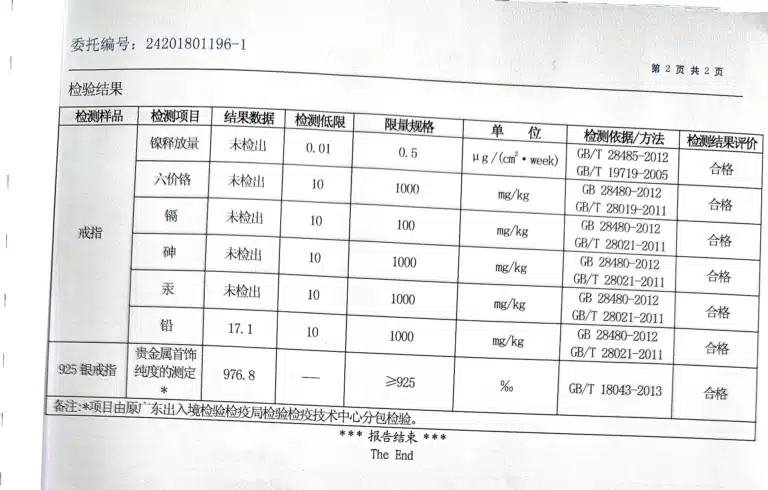
Amara publishes batch-level third-party safety data: assay to GB 28480-2012 under report No.24201801196-1, with cadmium reported as not detected, alongside nickel-release testing per EN 1811:2023 and SGS material-safety testing — see our page des certifications for the certificates and the full report pack. The practical next step for buyers is equally concrete: attach the arbitration-laboratory clause to the purchase order before production, so the retained samples are drawn and sealed at acceptance rather than improvised after a claim.